Class 8 Biology Question Paper 2017
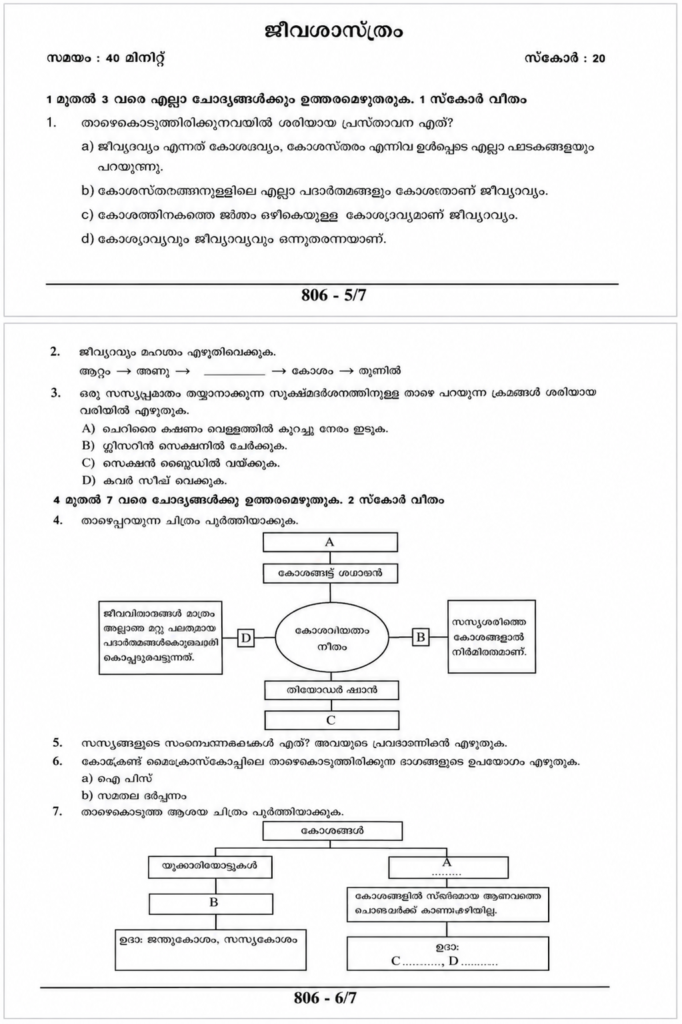
If you are searching for the Class 8 Biology Question Paper 2017, the paper shown above is a useful example of a Class 8 First Term Biology examination. After going through the complete paper carefully, it is clear that the questions mainly test students’ understanding of cells, cell biology, plant tissues, animal tissues, microscopes, and levels of organization in living organisms.
The paper is not based only on direct memorization. Several questions ask students to identify concepts, complete illustrations, interpret diagrams, match characteristics with tissues, and explain the functions of different structures.
The paper is a 40-minute, 20-score Biology examination and is divided into three main parts. The same 2017 paper is also indexed online as the Kerala Class 8 First Term Onam Exam Question Paper 2017 – Biology (English Medium). (Scribd)
Class 8 Biology Question Paper 2017 – Quick Overview
The question paper has a total time of 40 minutes and carries 20 marks.
The paper follows this structure:
| Section | Questions | Marks per Question | Attempt |
|---|---|---|---|
| Part 1 | 1–3 | 1 mark | All |
| Part 2 | 4–8 | 2 marks | Any 4 |
| Part 3 | 9–12 | 3 marks | Any 3 |
This structure makes the paper interesting because students are not simply asked to answer every question. They have to choose questions carefully in the higher-mark sections.
What Does the 2017 Biology Paper Actually Test?
After analyzing the questions, the strongest focus of the paper is clearly Cell Biology and Tissues.
The first section begins with a question about protoplasm, followed by a question on the sequence of organization:
Atom → Molecule → ______ → Cell → Tissue
Another question deals with the preparation of a plant section for microscopic observation, including why the specimen is kept in water and why glycerine is added.
So, right from the beginning, the paper checks whether students understand basic biological concepts rather than simply remembering isolated definitions.
Question 1 – Understanding Protoplasm
The first question asks students to identify the correct statement about protoplasm.
This is an important basic concept because students need to distinguish between terms such as:
- Protoplasm
- Cytoplasm
- Nucleus
- Plasma membrane
The question is presented as a multiple-choice question, making it a good test of conceptual clarity.
What students should remember
Protoplasm refers to the living material within the plasma membrane, including the cytoplasm and nucleus.
This type of question shows that the examination expects students to understand scientific terminology accurately.
Question 2 – Levels of Biological Organization
The second question asks students to complete:
Atom → Molecule → ______ → Cell → Tissue
This question tests the idea that living systems are organized in levels, moving from smaller units toward larger biological structures.
Students should understand that biological organization is not random. Cells form tissues, tissues form organs, and organs can work together as organ systems.
The concept of levels of organization is also commonly used in Class 8 Biology when studying cells and tissues. (Quizgecko)
Question 3 – Preparing a Plant Section for Microscopic Observation
The third question is more practical in nature.
Students are given two steps:
- Keeping the specimen in water for some time.
- Adding glycerine to the section.
They are asked to give reasons for these steps.
This is an excellent example of a question that tests understanding of laboratory procedures, not just textbook definitions.
The purpose of keeping a specimen in water is related to preventing it from drying out. Glycerine is used during slide preparation to help prevent drying and to prepare the specimen for observation.
Microscope-based observation and slide preparation are important parts of learning about cells and tissues. (HSSLive)
Part 2 – Two-Mark Questions
Questions 4 to 8 carry two marks each, and students have to answer any four.
This section increases the difficulty because students have to provide explanations, identify concepts, and interpret diagrams.
Question 4 – Cell Biology and Cell Theory
Question 4 contains an illustration related to the development of Cell Biology and important scientists.
The diagram refers to Robert Brown and Theodor Schwann, along with statements related to cell theory.
This means students need to know the historical development of cell biology as well as the basic ideas behind cell theory.
A useful way to revise this topic is to create a simple timeline of important scientists and their contributions.
Question 5 – Vascular Tissues of Plants
Students are asked to identify the vascular tissues of plants and write the function of each.
The two important vascular tissues are:
- Xylem
- Phloem
Xylem
Xylem mainly conducts water and minerals from the roots toward other parts of the plant.
Phloem
Phloem transports prepared food from the leaves to other parts of the plant.
This is a particularly important topic because questions about plant transport can be asked in several different forms.
Question 6 – Parts of a Compound Microscope
Students are asked to write the uses of:
- Eyepiece
- Plane mirror
This question shows that the paper is not restricted to theoretical Biology. It also tests practical knowledge of scientific instruments.
Students preparing for similar examinations should therefore learn the names and functions of the major parts of a compound microscope.
Question 7 – Prokaryotic and Eukaryotic Cells
The concept map in Question 7 divides cells into major categories.
Students are expected to understand:
- Eukaryotic cells
- Prokaryotic cells
- Presence or absence of a well-defined nucleus
- Examples of each type
The paper therefore tests both classification and characteristics.
A common mistake students make is remembering only the names but forgetting the defining feature. The most important distinction is the organization of the nucleus.
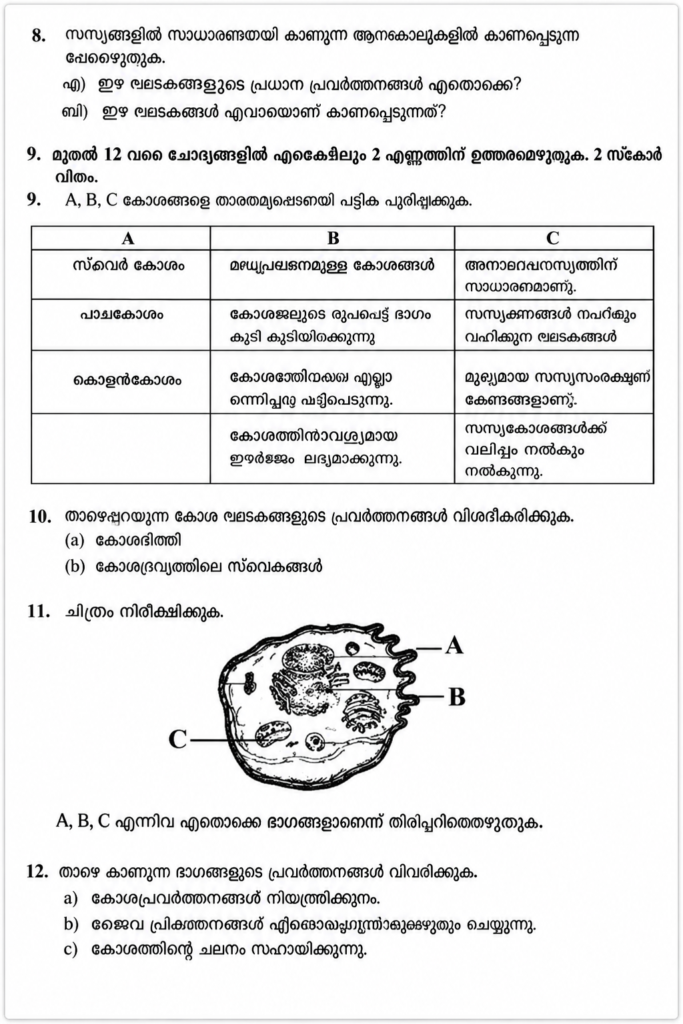
Question 8 – Cells at Growing Tips of Plants
Question 8 asks about the special cells found at the growing tips of plants.
These are meristematic cells, particularly associated with growth regions.
Students have to:
- Name the cells.
- Write any two features.
Important characteristics include active cell division and the presence of relatively small, actively growing cells.
Questions like this are easier when students understand why these cells are found at growing points rather than simply memorizing their name.
Part 3 – Three-Mark Questions
Questions 9 to 12 carry three marks each, and students have to answer any three.
This is the most descriptive part of the paper.
It requires students to combine identification, comparison, explanation, and diagram-based understanding.
Question 9 – Plant Tissues
Question 9 asks students to rearrange information in columns according to:
- Sclerenchyma
- Parenchyma
- Collenchyma
The clues include cell structure, wall thickness, location, flexibility, support, and conduction.
This is one of the most important topics in the entire paper.
Parenchyma
Parenchyma generally consists of living cells with relatively thin cell walls and is commonly associated with storage and other basic functions in plants.
Collenchyma
Collenchyma provides support while allowing flexibility in growing plant parts.
Sclerenchyma
Sclerenchyma provides strength and mechanical support and generally has thick, strengthened cell walls.
Students should learn these tissues by comparing their structure, location, and function instead of memorizing three separate paragraphs.
Question 10 – Connective Tissue
Question 10 states that cartilage and blood are connective tissues.
Students are asked why they are called connective tissues and to provide another example along with its function.
This question tests whether students understand the functional meaning of connective tissue.
Connective tissues help connect, support, bind, or transport materials within the body.
Examples include:
- Blood
- Cartilage
- Bone
- Adipose tissue
The important point is that different connective tissues can have very different structures and functions.
Question 11 – Identify Parts of a Plant Cell
Question 11 provides a labelled plant-cell illustration with A, B, and C.
Students have to identify the labelled structures and write their functions.
This is an important diagram-based question because students need to combine visual recognition with biological knowledge.
While preparing for Biology examinations, students should practice identifying:
- Cell wall
- Cell membrane
- Cytoplasm
- Nucleus
- Chloroplast
- Mitochondria
- Vacuole
- Other major cell structures included in their syllabus
The use of diagrams in cell questions is consistent with Class 8 Biology examination resources, where students are commonly asked to identify cell structures and explain their functions.
Question 12 – Animal Tissues and Their Functions
The final question asks students to name the tissues responsible for different functions:
Covering and protecting the body
Epithelial tissue
Controlling and coordinating physiological functions
Nervous tissue
Enabling movement of the body
Muscular tissue
This question is a good example of how the paper connects the function of a tissue with its name.
Students should therefore revise animal tissues through function-based questions rather than only learning definitions.
Overall Analysis of the Class 8 Biology Question Paper 2017
After looking at the complete paper, we can divide the major topics into a few clear groups.
1. Cell Biology
This is one of the strongest areas in the paper.
Questions involve:
- Protoplasm
- Cell theory
- Cell organization
- Plant cells
- Cell structures
- Prokaryotic and eukaryotic cells
2. Plant Tissues
Another major focus is plant tissues.
The paper includes:
- Vascular tissues
- Meristematic cells
- Parenchyma
- Collenchyma
- Sclerenchyma
- Xylem
- Phloem
3. Animal Tissues
The paper also tests:
- Connective tissue
- Epithelial tissue
- Nervous tissue
- Muscular tissue
4. Microscope and Practical Biology
The paper includes practical knowledge related to:
- Compound microscope
- Eyepiece
- Plane mirror
- Plant section preparation
- Water
- Glycerine
This makes the paper more application-oriented than a paper based entirely on definitions.
Difficulty Level of the Paper
The overall difficulty of this paper can be considered moderate for a well-prepared Class 8 student.
The one-mark questions are comparatively straightforward, but the two- and three-mark questions require better understanding.
The more challenging parts are:
- Completing concept maps
- Understanding cell theory
- Matching plant tissues with characteristics
- Interpreting diagrams
- Identifying cell structures
- Explaining tissue functions
A student who has only memorized definitions may find some of these questions difficult.
A student who has understood the concepts and practiced diagrams should be able to handle them more comfortably.
How to Prepare Using the Class 8 Biology Question Paper 2017
The best way to use this paper is not simply to read it once.
Try this approach.
Step 1 – Read the relevant chapters
First revise the chapters related to cells and tissues.
Step 2 – Learn important terms
Make sure you understand terms such as:
- Protoplasm
- Cytoplasm
- Cell membrane
- Cell wall
- Tissue
- Xylem
- Phloem
- Meristematic tissue
- Parenchyma
- Collenchyma
- Sclerenchyma
- Epithelial tissue
- Nervous tissue
- Muscular tissue
- Connective tissue
Step 3 – Practice diagrams
Practice plant-cell diagrams, microscope-related diagrams, and tissue illustrations.
Step 4 – Solve the paper without notes
Set a timer for 40 minutes and attempt the paper just like an actual examination.
Step 5 – Check your mistakes
Do not simply count your marks.
Look at why you made each mistake.
Was it:
- A forgotten definition?
- A confusing scientific term?
- A diagram-identification mistake?
- A misunderstanding of a tissue function?
- A time-management problem?
This analysis is much more useful than simply knowing the final score.
Important Topics to Revise Before the Exam
Based on the questions in this paper, students should give special attention to:
- Protoplasm and cytoplasm
- Levels of biological organization
- Cell theory
- Scientists associated with cell biology
- Compound microscope
- Plant section preparation
- Xylem and phloem
- Meristematic cells
- Prokaryotic and eukaryotic cells
- Plant tissues
- Parenchyma
- Collenchyma
- Sclerenchyma
- Connective tissue
- Plant-cell structures
- Epithelial tissue
- Nervous tissue
- Muscular tissue
These topics also appear frequently in Class 8 resources dealing with cells, organelles, and tissues. (Scribd)
A Student-Friendly Way to Remember Plant Tissues
Instead of trying to memorize everything separately, remember the basic idea:
Parenchyma → basic living tissue and storage-related functions
Collenchyma → flexibility and support
Sclerenchyma → strength and mechanical support
Then revise their structure and location.
For vascular tissues:
Xylem → water and minerals
Phloem → prepared food
This simple association makes revision much quicker.
Why This Question Paper Is Useful Even Today
Although the paper is from 2017, it remains useful as a practice and revision resource because the fundamental concepts of cells, tissues, microscopes, and biological organization are important foundations of Biology.
The value of an old question paper is not necessarily that the exact questions will appear again. Its real value is that it shows students how a syllabus can be converted into different types of examination questions.
For example, one topic such as plant tissues can become:
- A definition question
- A matching question
- A diagram question
- A comparison question
- A function-based question
That is why students should practice different question formats rather than memorizing only one answer.
Final Thoughts
The Class 8 Biology Question Paper 2017 is a compact but concept-focused paper. Its 40-minute format requires students to work efficiently, while the different mark sections test both basic knowledge and deeper understanding.
The biggest takeaway from the paper is that Cell Biology and Tissues are extremely important areas for preparation. Students should be comfortable with definitions, functions, comparisons, diagrams, and practical microscope-related concepts.
If you are preparing for a similar Class 8 Biology examination, do not wait until the final day to revise these topics. Read the chapter, understand the concept, practice the diagram, and then solve the previous paper without looking at your notes.
That way, the question paper becomes more than just an old exam paper—it becomes a practical test of how well you actually understand Biology.
Frequently Asked Questions
Q. What is the duration of the Class 8 Biology Question Paper 2017?
The paper shown here has a duration of 40 minutes.
Q. What is the total score?
The total score is 20.
Q. Which topics are mainly covered?
The paper mainly focuses on cells, cell biology, microscopes, plant tissues, animal tissues, and biological organization.
Q. Are diagrams included in the paper?
Yes. The paper includes concept maps, illustrations, and a plant-cell diagram that students have to interpret.
Q. Is the paper useful for revision?
Yes. It is particularly useful for practicing cell and tissue-related concepts and for understanding how questions can be presented in different formats.
Q. Should students memorize the answers?
It is better to understand the concepts first. Once the concepts are clear, remembering the important points becomes much easier.