| Supervisor’s Signature |
Marks | ||
| Examiner’s Signature |
Total |
Student’s Name : ______________________________________ Roll No. _____ Div _____
| 1. A) Choose correct alternative and write it along with its allotted alphabet. | 2 |
-
1) Product of mass and velocity of an object is ______________
a) force b) momentum c) velocity d) aeeceleration -
2) The potential energy of your body is least when you are ______________
a) sitting on a chair b) sitting on a ground c) sleeping on a ground d) standing on a ground.
| B) State whether the following statements are true or false. | 2 |
- 1) The kinetic energy of the body of mass 2 kg, moving with a velocity of 2m/s is 4J. ___________________
- 2) Change in momentum occurs in direction of force. ___________________
| 2. A) Give scientific reasons (Any 1) | 2 |
- 1) Why is work done on an object moving with uniform circular motion zero ?
- 2) The valency of oxygen is 2
__________________________________________________________________________________________
__________________________________________________________________________________________
| B) Give answers of the following questions. (Any – 1) | 2 |
- 1) Give different transformation of electric energy, with examples
- 2) State Newtons first law of motion.
__________________________________________________________________________________________
| 3. Give answers of the following questions. (Any 3) | 6 |
- 1) Give difference between Kinetic energy & potential energy
-
2) A striker of mass 15 gm with velocity 10 m/s collide on a carrom board pebble of mass 6gm which is at rest. If pebble moves with velocity 20 m/s collision. Find the velocity of a striker after collision.
3) Correct following diagram and label its parts.
-
4) Deduce the molecular masses of the following compounds with the help of atomic masses of elements given below.
( H = 1, O = 16, Na = 23, Mg = 24, Cl = 35.5 )
Molecular formula – NaOH, H2O, MgCl2, MgO, O2, NaCl__________________________________________________________________________________________
__________________________________________________________________________________________
__________________________________________________________________________________________
__________________________________________________________________________________________
__________________________________________________________________________________________
| 4. Give answers of the following question. (Any 1) | 3 |
-
1) Complete the following paragraph by using appropriate option given below.
[element, IUPAC, small, Berzelius, capital, copper]Dalton used certain signs represent elements for example • for hydrogen, (C) for ____________________. Today we are use the symbols determined by ____________________. The current method of choosing chemical symbols is based on the method invented by ____________________. according to this method the symbol of an ____________________ is either the first letter or the first and second/another specific letter in its name of the two letters, the first is a ____________________ letter and the second is ____________________. -
2) Complete the activity to find effective resistance of resistors in series.
Two resistors R1 and R2 are connected in series in the circuit. Lets the voltages across them be V1 & V2 respectively then,V = V1 + ———— ①
If Rs is the effective resistance between CD, then according to law.
V = IRs ∴ V1 = and V2 = IR2
substituting these values in eq ———— ①
IRs = + IR2
= = + R2
| 1. A) Choose correct option. | 2 |
-
1) ____________________ Plants have soft and fiber like body.
a) Bryophyta b) Thallophyta c) Pteridophyta d) Angiosperms -
2) Period required for degradation of thermocol is ____________________ years.
a) 1 Month b) 40 to 50 Years c) 200 to 250 Years d) infinite duration
| B) Write the answers. | 2 |
- 1) Identify the odd word out – Pneumonia, Diphtheria, Chicken pox, Cholera. ____________________
- 2) State true or false – Parallel venation present in monocotyledonous plants. ____________________
| 2. A) Give scientific reasons. (Any 1) | 2 |
- 1) Foam accumulates on a surface of ‘dal’ kept for a long time in summer.
- 2) Flow of nutrients through an ecosystem is cyclic.
__________________________________________________________________________________________
__________________________________________________________________________________________
| B) Answer the following questions. (Any Two) | 2 |
-
1) Define – Trophic level.
__________________________________________________________________________________________
-
2) Write the two examples of division pteridophyta.
a) ____________________________________________________________________________________
b) ____________________________________________________________________________________ -
3) Write the two characteristics of dicotyledonous plants.
__________________________________________________________________________________________
__________________________________________________________________________________________ -
4) Complete the equation –
C6H12O6 + 6O2 —————→Mitochondria + + Energy
| 3. Answer the following questions. (Any 4) | 8 |
- 1) Difference between gaseous cycle and sedimentary cycle.
- 2) Write the two characteristics of spirogyra.
- 3) Write the two uses of lactobacilli bacteria.
| 1. A) Choose correct option. | 2 |
-
1) ____________________ Plants have soft and fiber like body.
a) Bryophyta b) Thallophyta c) Pteridophyta d) Angiosperms -
2) Period required for degradation of thermocol is ____________________ years.
a) 1 Month b) 40 to 50 Years c) 200 to 250 Years d) infinite duration
| B) Write the answers. | 2 |
- 1) Identify the odd word out – Pneumonia, Diphtheria, Chicken pox, Cholera. ____________________
- 2) State true or false – Parallel venation present in monocotyledonous plants. ____________________
| 2. A) Give scientific reasons. (Any 1) | 2 |
- 1) Foam accumulates on a surface of ‘dal’ kept for a long time in summer.
- 2) Flow of nutrients through an ecosystem is cyclic.
__________________________________________________________________________________________
__________________________________________________________________________________________
| B) Answer the following questions. (Any Two) | 2 |
-
1) Define – Trophic level.
__________________________________________________________________________________________
-
2) Write the two examples of division pteridophyta.
a) ____________________________________________________________________________________
b) ____________________________________________________________________________________ -
3) Write the two characteristics of dicotyledonous plants.
__________________________________________________________________________________________
__________________________________________________________________________________________ -
4) Complete the equation –
C6H12O6 + 6O2 —————→Mitochondria + + Energy
| 3. Answer the following questions. (Any 4) | 8 |
- 1) Difference between gaseous cycle and sedimentary cycle.
- 2) Write the two characteristics of spirogyra.
- 3) Write the two uses of lactobacilli bacteria.
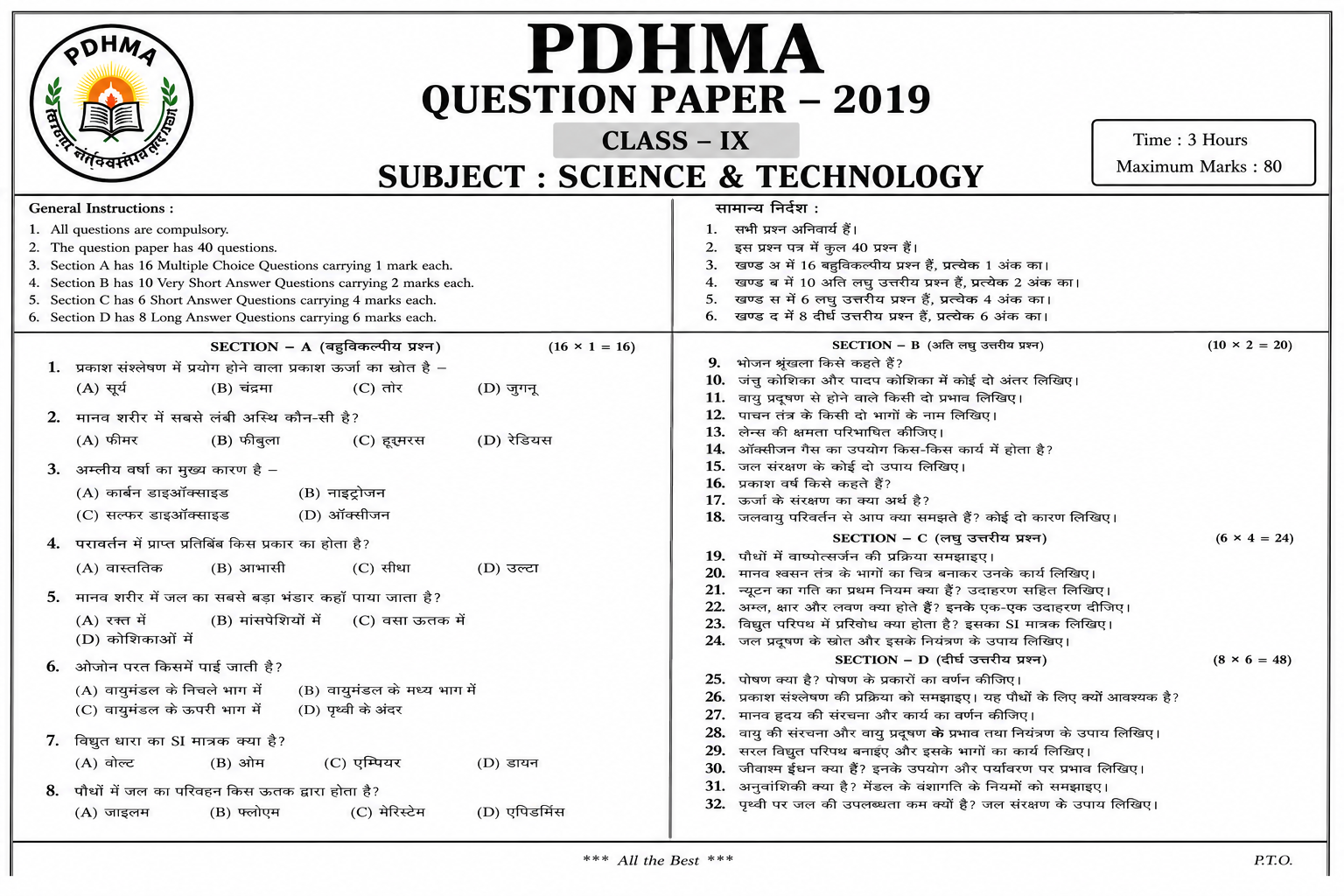
PDHMA Question Paper 2019 9th: Science & Technology Paper
Class 9 Science and Technology previous-year question paper, revision strategy, examination preparation, important study areas, answer-writing tips and practice guidance.
PDHMA Question Paper 2019 9th: Science & Technology Paper
The PDHMA Question Paper 2019 9th Science & Technology Paper is a useful search topic for students looking for previous-year Class 9 Science and Technology examination material. Science and Technology is a concept-based subject, so regular practice is important for understanding scientific ideas, remembering important terms and answering questions accurately.
A previous-year question paper can be used as a practice resource after students have studied the relevant chapters. Instead of simply reading the questions, students should attempt them independently and then analyse their performance. This helps them understand which topics they know well and which topics require additional revision.
The PDHMA 9th Science and Technology Question Paper 2019 can therefore be included as part of a broader preparation strategy. Students should combine previous-year paper practice with their current syllabus, prescribed textbook, classroom notes and chapter-wise exercises.
The 2019 paper is a previous-year resource. Students should use the current syllabus and current examination instructions as the primary basis for present-day preparation. Exact marks, question count and paper structure should be verified from the original paper rather than assumed.
About PDHMA 9th Class Science & Technology Paper 2019
The PDHMA Question Paper 2019 9th: Science & Technology Paper can help Class 9 students practise different types of science-related questions. Science examinations may require students to remember definitions, explain concepts, solve numerical problems, interpret information, identify scientific principles and apply knowledge to situations.
For this reason, students should not prepare Science and Technology only by memorising answers. A strong preparation method combines conceptual learning with repeated question-solving practice.
Previous-year papers can also help students understand how they should present answers. A student may know the correct concept but still lose effectiveness if the answer is incomplete, unclear or poorly organised. Practising written responses can help improve this skill.
The 2019 paper can be used at different stages of preparation. Students may attempt selected questions after completing individual chapters, or they may attempt the complete paper after finishing their syllabus as a mock examination.
PDHMA Question Paper 2019 9th Science and Technology – Basic Details
| Particular | Details |
|---|---|
| Subject | Science & Technology |
| Class | 9th Class |
| Question Paper Year | 2019 |
| Question Paper Type | Previous-Year Question Paper |
| Main Purpose | Practice, Revision and Self-Assessment |
| Useful For | Students, Teachers and Parents |
| Preparation Method | Concept Study + Question Practice + Revision |
Why Solve the PDHMA 9th Science & Technology Question Paper 2019?
Science is easier to prepare when students combine conceptual understanding with regular practice. A previous-year question paper provides an opportunity to test whether a student can recall and apply the concepts studied in the textbook.
🔬 Concept Practice
Students can use questions to check whether they actually understand scientific concepts instead of only recognising them while reading a textbook.
📚 Revision
Question papers provide a practical way to revise several topics and identify chapters that need additional attention.
📝 Answer Writing
Regular written practice helps students learn how to explain scientific concepts clearly and accurately.
🧮 Problem Solving
Where numerical or application-based questions are included in the syllabus, practice can improve calculation and problem-solving skills.
⏱ Time Management
Timed practice helps students learn how to distribute examination time among different questions.
🎯 Self-Assessment
After completing a paper, students can identify strong areas and topics that need further revision.
How to Prepare for Class 9 Science & Technology
Class 9 Science and Technology preparation should begin with a clear understanding of the current syllabus. Students should identify every chapter and divide their preparation into manageable study sessions.
Start With the Textbook
The prescribed textbook should be the foundation of preparation. Read each chapter carefully and understand the explanations, examples, activities, illustrations and important terms.
Understand Before Memorising
Scientific concepts are easier to remember when students understand why and how something happens. Try to explain a concept in your own words after studying it.
Make Short Notes
Short notes can be useful during revision. Write important definitions, scientific terms, formulas, processes and key points in a simple format.
Practise Questions
After studying a chapter, solve its exercises. Once several chapters are complete, use previous-year questions for broader practice.
Review Mistakes
Every incorrect answer should be analysed. Find out whether the mistake was caused by a lack of understanding, poor recall, incorrect calculation or misreading of the question.
Important Areas of Science & Technology Preparation
The exact chapters and topics depend on the relevant syllabus. Students should always follow their current textbook and curriculum. However, Science and Technology preparation generally requires attention to several broad types of scientific learning.
Scientific Concepts
Students should understand the main principles explained in each chapter. Instead of memorising sentences, focus on understanding the scientific idea behind them.
Definitions and Terminology
Important scientific terms should be learned accurately. Students should also understand their meanings so that they can use them correctly in explanations.
Processes and Explanations
Where the syllabus includes scientific processes, students should understand the sequence of events and be able to explain the process logically.
Diagrams and Labelling
If diagrams are part of the current syllabus, students should practise drawing and labelling them accurately.
Numerical and Application-Based Questions
Where relevant, students should practise formulas, calculations and the application of scientific principles to problems.
How to Solve PDHMA 9th Science & Technology Paper
Students should approach a Science and Technology question paper carefully. Reading the question correctly is often as important as knowing the answer.
- Read the complete question. Make sure you understand exactly what is being asked.
- Identify important keywords. Words such as define, explain, compare, calculate, identify, describe and give reasons indicate what type of response may be required.
- Recall the relevant concept. Think about the chapter and principle related to the question before writing.
- Write a focused answer. Give the information required by the question and avoid unnecessary repetition.
- Use correct scientific terms. Scientific terminology should be written accurately.
- Show calculations where required. For numerical problems, write the relevant steps clearly rather than giving only the final result.
- Review the answer. Check calculations, units, diagrams, labels and incomplete responses before finishing.
Types of Questions Students Should Practise
Science and Technology examinations can contain different forms of questions. Students should therefore practise more than one question type.
Definition-Based Questions
These questions require a precise explanation of a scientific term. Students should learn important definitions from their current syllabus and understand their meanings.
Short Answer Questions
Short questions require focused answers. Students should identify the central point and respond directly.
Explanation Questions
Explanation questions require students to describe how or why something happens. Answers should include the relevant scientific reasoning.
Difference Questions
When comparing two concepts, students can organise the answer using separate points or a table where appropriate.
Reason-Based Questions
For questions asking why something happens, students should provide the scientific reason rather than only stating the result.
Numerical Questions
Where numerical problems are included in the syllabus, students should practise writing formulas, substituting values and showing calculations clearly.
Diagram-Based Questions
Students should practise relevant diagrams and labels if they are included in the current curriculum.
How to Improve Science Answer Writing
Science answers should be clear, accurate and relevant. Students should avoid writing extremely long answers when a short response is sufficient.
For explanation questions, include the important scientific points in a logical order. If a process has multiple stages, present the stages clearly.
For numerical questions, write the formula and important calculation steps. For diagrams, use clear labels where required.
Students should also check scientific spellings and units. A small mistake in a scientific term or unit can affect the clarity of an answer.
Understand the question → Identify the concept → Write the relevant points → Check accuracy.
Using the 2019 Science & Technology Paper as a Mock Test
One of the most effective ways to use the PDHMA Question Paper 2019 9th Science & Technology Paper is to attempt it as a mock test.
Choose a quiet environment and keep your textbook and notes aside. Set a reasonable time limit based on the paper and your examination requirements.
Attempt the paper independently. Avoid checking answers after every question. Complete the paper first and then evaluate your performance.
After finishing, create three lists: questions answered correctly, questions answered incorrectly and questions where you were unsure. The second and third lists should receive additional attention during revision.
Study → Attempt Paper → Check Answers → Analyse Mistakes → Revise → Practise Similar Questions.
How to Analyse Mistakes After Solving the Paper
Simply checking the final score is not enough. Students should analyse why mistakes happened.
Conceptual Mistake
If you did not understand the concept, return to the relevant textbook section and study it again.
Recall Mistake
If you understood the topic but forgot an important term, fact or formula, add it to your revision notes.
Calculation Mistake
For numerical questions, check whether the correct formula, units and calculation steps were used.
Question Interpretation Mistake
Sometimes students know the concept but misunderstand the wording of the question. Careful reading can help reduce this problem.
Careless Mistake
Missing a label, unit, word or calculation sign can create an avoidable error. Reviewing completed papers can help students identify these patterns.
Science & Technology Revision Strategy
A good revision strategy should divide the subject into manageable sections. Students should avoid leaving the entire syllabus for the final days.
- Read each chapter carefully.
- Understand the main scientific concepts.
- Revise important terminology.
- Make short notes for difficult topics.
- Practise textbook exercises.
- Practise numerical questions where relevant.
- Review diagrams and labels where required.
- Solve previous-year questions.
- Analyse mistakes after every practice session.
- Revise weak chapters more frequently.
How to Prepare Numerical Questions in Science
Where the Science and Technology syllabus includes numerical problems, students should practise them regularly. Understanding a formula is not enough; students should know when and how to apply it.
Start by identifying the information provided in the question. Then determine which scientific principle or formula is relevant. Substitute the values carefully and check the final unit.
Students should avoid memorising only solved examples. Practise different questions based on the same concept so that you learn how to identify the correct method.
If a calculation goes wrong, repeat the problem from the beginning and identify the exact step where the mistake occurred.
Importance of Diagrams in Science Preparation
Diagrams can make scientific concepts easier to understand and remember. Where diagrams are required by the current syllabus, students should practise them regularly.
A good diagram should be neat and clearly labelled. Students should understand what each labelled part represents instead of memorising the appearance of the diagram alone.
Practise drawing important diagrams without looking at the textbook. Afterwards, compare your diagram with the textbook and correct missing or incorrect labels.
Common Mistakes in Class 9 Science Preparation
Only Memorising Answers
Memorising answers without understanding concepts can make it difficult to answer questions that are worded differently.
Ignoring Difficult Chapters
Students sometimes avoid topics they find difficult. These topics should instead receive additional practice.
Not Practising Calculations
Reading solved numerical examples is not enough. Students should solve problems independently.
Ignoring Scientific Terms
Important terminology should be understood and used correctly.
Skipping Revision
Learning a chapter once does not guarantee long-term recall. Regular revision is necessary.
Not Analysing Mistakes
A practice paper is most useful when students learn from the mistakes made while solving it.
Time Management for the Science & Technology Paper
Time management is an important part of examination preparation. Students should practise answering questions within an appropriate amount of time.
At the beginning of the paper, read the questions carefully and identify those you understand well. Answering familiar questions can help ensure that known answers are not left incomplete.
Do not spend too much time on one difficult problem. Move ahead when necessary and return to the difficult question later if time permits.
Always keep some time for checking calculations, units, diagrams, labels and unanswered questions.
Speed should not come at the cost of accuracy. The goal is to complete the paper while maintaining clear and correct answers.
How Parents Can Help Students Prepare for Science
Parents can support Class 9 students by helping them establish a regular study routine. A quiet environment and a consistent schedule can make science preparation easier.
Parents do not need to provide answers to difficult questions immediately. Instead, they can encourage students to review the relevant chapter and try the question again.
After a practice paper, parents can ask students which chapters were difficult. This can help students become more aware of their own learning needs.
Encouragement is especially important when students make mistakes. Practice papers are designed to identify weaknesses before the actual examination.
How Teachers Can Use Previous-Year Science Questions
Teachers can use previous-year questions as supplementary classroom practice. A question from the 2019 paper can be discussed and then followed by new questions based on the same concept.
Teachers can also ask students to explain the reasoning behind an answer. This helps determine whether students understand the concept or have simply memorised a response.
Another useful classroom activity is to ask students to create a new question based on a concept from an old question. This encourages deeper understanding and application.
Final Revision Strategy for Class 9 Science & Technology
As the examination approaches, students should focus on revision rather than trying to learn everything from the beginning. Review the current syllabus and identify chapters that require additional attention.
Use the PDHMA Question Paper 2019 9th Science & Technology Paper as one of the practice resources. Attempt the paper under suitable conditions and analyse your mistakes afterwards.
Review important concepts, terminology, formulas and diagrams according to the current syllabus. Practise questions from areas where your performance was weak.
Students should also get enough rest before the examination. A calm and organised approach can make revision more effective.
Current Syllabus + Textbook Study + Concept Understanding + Question Practice + Revision + Mistake Analysis.
Frequently Asked Questions
What is PDHMA Question Paper 2019 9th Science & Technology?
It refers to a previous-year Class 9 Science and Technology question paper associated with the 2019 examination period. It can be used for supplementary practice and revision.
Why should I practise the 2019 Science and Technology paper?
It can help you practise scientific concepts, answer writing, problem solving, revision and examination time management.
Can I prepare only from the 2019 paper?
No. Students should prepare primarily from the current syllabus and prescribed textbook. The previous-year paper should be used as additional practice.
Should I memorise answers from the old paper?
No. Understanding scientific concepts is more useful because questions may be worded differently in another examination.
How can I improve Science and Technology marks?
Understand concepts, revise regularly, practise questions, solve numerical problems where applicable, review diagrams and analyse mistakes after practice.
How should I practise numerical questions?
Understand the relevant formula or principle, identify the information given, solve the problem step by step and check the final unit.
Should I practise diagrams?
If diagrams are part of your current syllabus, yes. Practise drawing and labelling important diagrams accurately.
What should I do after making mistakes?
Identify why the mistake occurred, revise the related concept and practise similar questions again.
Is time management important in Science?
Yes. Students should practise completing questions within an appropriate amount of time while leaving enough time for checking answers.
Conclusion
The PDHMA Question Paper 2019 9th: Science & Technology Paper can be a useful supplementary resource for Class 9 students who want to strengthen their examination preparation. Previous-year question papers allow students to test their understanding, practise written answers and identify topics that require additional revision.
Students should not depend only on an old question paper. The current syllabus, prescribed textbook and classroom learning should remain the foundation of preparation. The 2019 paper can then be used to test overall understanding and improve examination skills.
Science and Technology preparation is most effective when students understand concepts rather than simply memorising answers. Regular practice, careful answer writing, numerical problem-solving where applicable, diagram practice and mistake analysis can make preparation more systematic.
The most useful study cycle is simple: Understand → Practise → Check → Analyse → Revise → Practise Again.
By following this approach consistently, Class 9 students can use the PDHMA Question Paper 2019 9th Science & Technology as a valuable part of their revision strategy while continuing to follow the requirements of their current academic syllabus.