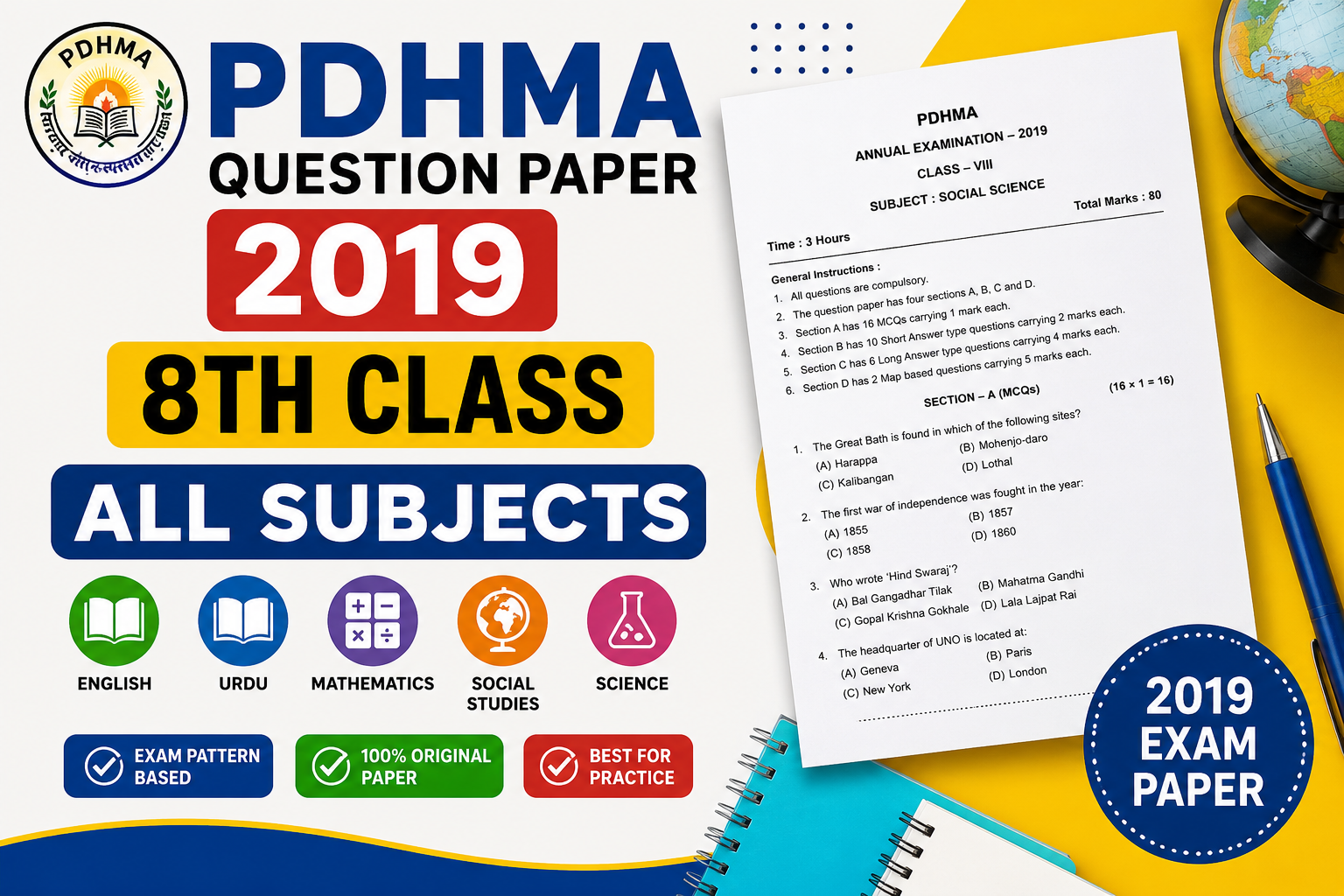
The PDHMA Question Paper 2019 8th is a useful study resource for Class 8 students. By practicing the PDHMA Question Paper 2019 8th, students can understand the exam pattern, important questions, and marking scheme. Download the PDHMA Question Paper 2019 8th to improve your preparation and perform better in the examination.
| Notes :- | 1) | All questions are compulsory. |
| 2) | Draw neat diagrams with pencil. |
| 1. A) Fill in the blanks. (any four) | 5 |
- 1) The SI unit of force is the ………………..
- 2) Milk is an example of type of matter called ………………..
- 3) An electron carries a ……………….. charge.
- 4) The Pascal is the unit of ………………..
- 5) Malaria is caused by female mosquito of ……………….. genus.
| ‘A’ group | ‘B’ group |
|---|---|
| 1) Protons | a) Mixture |
| 2) air | b) Amoeba |
| 3) Algae | d) Positively charged |
| 4) blunt knife | e) Chlorella |
| 5) Protozoa | f) Lower Pressure |
| 2. A) Give Scientific reasons (any three) | 6 |
- 1) Drawing pins have flattened heads.
- 2) Water is a compound
- 3) Sodium metal is kept in kerosene
- 4) A sheet of metal that sinks in water can float if shaped like a pan.
| B) Who am I ? | 2 |
- 1) I live on decaying organic matter
- 2) I am green but don’t have organs.
| C) Identify the odd term | 2 |
- 1) Plague, AIDS, cholera, T. B.
- 2) Gold, Silver, Copper, Brass.
| 3. A) Answer the following questions in one sentence (only 6) | 6 |
- 1) What is meant by a solution ?
- 2) Which is meant by Atomic mass number ?
- 3) Which the hardest natural substance in the form of carbon in the world.
- 4) In which unit purity of gold is measured.
- 5) What is specitic gravity ?
- 6) What is pollution ?
- 7) What is potentioal difference ?
| B) Distinguish between the following (any two) |
- 1) Metals and Non-metals
- 2) Solids and Gases
- 3) Protron and Neutron
| 4. A) Answer in short (any three) | 6 |
- 1) What are the causes and symptoms of diabetes !
- 2) What are the uses & Noble metals ?
- 3) What is green house effect ?
- 4) How is rabies caused ? What are the important symptoms of the rabies ?
| B) Explain the following reactions with the help & balanced equations (any two). | 4 |
- 1) Sodium reacts with water
- 2) Carbon burns in air
- 3) Magnesium reacts with Oxygen.
| 5. Write short notes. (any two) | 6 |
- 1) Buoyant force
- 2) Generic medicines
- 3) Balanced diet
| B) Draw neat labelled diagrams (any two) |
-
1) Fungi
-
2) Paramoecium
-
3) Euglena
PDHMA Question Paper 2019 8th Class: General Science Question Paper
Complete guide for Class 8 General Science question paper practice, revision, concept preparation, self-assessment and examination readiness.
PDHMA Question Paper 2019 8th Class: General Science Question Paper
The PDHMA Question Paper 2019 8th Class: General Science Question Paper is a useful search topic for students looking for previous-year Class 8 General Science examination material. Previous-year question papers can play an important role in school-level examination preparation because they allow students to practise answering questions after completing their lessons.
General Science is a subject that combines concepts, facts, observations, definitions, explanations and practical understanding. Students therefore need more than simple memorisation. They should understand scientific concepts and learn how to explain them in their own words.
A previous-year General Science question paper can help students test whether they are able to recall and apply the concepts they have studied. It can also help students identify chapters that require additional revision.
The 2019 paper should be treated as a previous-year practice resource. Students should always give priority to their current Class 8 syllabus, prescribed textbook and current examination instructions.
About PDHMA Class 8 General Science Question Paper 2019
The PDHMA 8th Class General Science Question Paper 2019 can be used as a practice and revision resource by students who want to become familiar with science-based examination questions. A previous-year paper gives students an opportunity to move from passive reading to active problem solving.
When students read a science chapter, they may understand the explanation while looking at the textbook. During an examination, however, the textbook is not available. Students must recall the information and use it to construct an appropriate answer. This is why question-paper practice is important.
Students can use the 2019 question paper at different stages of preparation. It can be used after completing individual chapters, after finishing a group of chapters, or during full-syllabus revision.
The paper can also be useful for teachers who want additional questions for classroom discussion and revision activities. Parents can encourage students to attempt the questions independently and then discuss difficult concepts.
PDHMA Question Paper 2019 8th Class General Science – Basic Details
| Particular | Details |
|---|---|
| Subject | General Science |
| Class | 8th Class |
| Question Paper Year | 2019 |
| Question Paper Type | Previous-Year Question Paper |
| Primary Use | Practice and Revision |
| Useful For | Students, Teachers and Parents |
| Preparation Area | General Science Examination Preparation |
Why Practise the PDHMA 8th Class General Science Question Paper?
Science requires students to understand relationships between concepts. A question paper provides a practical opportunity to test that understanding. Students can discover whether they can explain a topic without looking at the textbook.
📘 Concept Revision
Question-paper practice helps students recall concepts that they studied earlier. It can reveal which topics have been forgotten and need revision.
🔬 Scientific Understanding
Science questions often require students to explain processes and observations. Practice helps students develop the ability to express scientific ideas clearly.
📝 Answer Writing
Students learn how to organise answers, use appropriate scientific terms and include the important points required by a question.
🎯 Self-Assessment
A completed paper gives students an opportunity to evaluate their preparation and identify weak chapters.
⏱ Time Management
Timed practice helps students understand how to manage their time when answering different types of science questions.
💡 Confidence
Regular practice can make students more comfortable with examination-style questions and improve their confidence.
How to Study General Science for Class 8
Students should begin General Science preparation by understanding the current syllabus. Once the syllabus is clear, divide the subject into manageable chapters and topics.
Do not try to memorise an entire chapter in one sitting. Read the topic carefully, understand the main idea, study the examples and then attempt questions related to that topic.
Science learning becomes easier when students connect concepts with everyday observations. Many scientific principles can be understood more effectively when students think about how they appear in real-life situations.
Read the Chapter Carefully
Start with the prescribed textbook. Read the complete chapter instead of studying only selected questions. Pay attention to headings, definitions, examples, illustrations and activities.
Understand Scientific Terms
Make a list of important scientific terms and understand their meanings. Memorising a definition without understanding the concept can make it difficult to answer questions that are worded differently.
Practise Explanations
After reading a concept, close the book and explain it in your own words. This is an effective way to check whether you actually understand the topic.
Use Questions for Testing
After completing several chapters, use the PDHMA Question Paper 2019 8th Class General Science as a practice test.
How to Solve the General Science Question Paper
Students should approach a science question paper systematically. The objective is not just to complete the paper quickly but to demonstrate accurate understanding of the subject.
- Read the instructions carefully. Understand what the question requires before writing the answer.
- Read the complete question. Do not begin writing after reading only the first part of a long question.
- Identify the key words. Words such as define, explain, compare, identify, describe and give reasons can indicate the type of response expected.
- Answer what is actually asked. Avoid adding large amounts of unrelated information.
- Use scientific terminology correctly. Important terms should be written accurately.
- Review difficult questions later. If a question is taking too much time, move ahead and return to it later.
- Check the completed paper. Review definitions, explanations, diagrams, labels and other answers before finishing the test.
Important General Science Preparation Areas
The exact chapters included in an examination depend on the relevant syllabus. Therefore, students should use their current textbook and syllabus to determine the topics they need to study.
However, Class 8 General Science preparation commonly involves several kinds of scientific learning. Students may encounter topics involving living organisms, materials, physical processes, environmental concepts, energy, force, matter and everyday scientific observations depending on their curriculum.
Instead of preparing only selected questions, students should understand the main concepts of every chapter included in their current syllabus.
Use the previous-year question paper to discover the kinds of answers you need to practise, but use the current textbook and syllabus to decide what you need to study.
General Science Question Types Students Should Practise
Science examinations can contain different styles of questions. Students should practise more than one type of response.
Definitions
Students should learn how to provide short and accurate definitions of important scientific terms. A definition should focus on the essential meaning rather than unnecessary details.
Short Answer Questions
Short-answer questions usually require a focused response. Students should identify the main point and answer directly.
Explanation Questions
For explanation-based questions, students should describe the concept logically and include the important steps or reasons.
Difference Between Questions
Comparison questions can be answered using clearly separated points or a simple table when appropriate.
Reason-Based Questions
For questions asking why something happens, students should explain the relevant scientific principle instead of giving only a one-word answer.
Diagram-Based Questions
Where diagrams are part of the current syllabus, students should practise drawing, labelling and identifying important parts accurately.
How to Improve General Science Answer Writing
Good answer writing is an important part of science preparation. Students should avoid writing extremely long answers when the question requires only a short response. At the same time, an explanation question should contain enough information to demonstrate understanding.
Use clear sentences and appropriate scientific vocabulary. If a process has several steps, present those steps in the correct order.
For comparison questions, a table can make differences easier to understand. For process questions, numbered points may be useful. Where diagrams are required, labels should be clear and correctly placed.
Students should also check spelling of scientific terms because incorrect spelling can sometimes change the meaning of a word.
Using the 2019 General Science Paper as a Mock Test
One of the best ways to use a previous-year question paper is to turn it into a mock test. Choose a quiet place, keep your textbook aside and attempt the paper without assistance.
The purpose of the mock test is to reproduce some of the conditions of an examination. Students should work independently and maintain a realistic time limit.
After finishing, do not immediately move on to another subject. Spend some time analysing the paper. Identify questions you answered incorrectly, questions you were unsure about and questions that consumed too much time.
Attempt the paper → Check answers → Find mistakes → Revise concepts → Practise similar questions.
How to Analyse Mistakes After the Question Paper
Mistake analysis is one of the most valuable parts of previous-year paper practice. Students should classify mistakes instead of treating every incorrect answer in the same way.
Conceptual Mistake
This happens when the student does not understand the underlying concept. The solution is to return to the textbook and study the concept again.
Memory Mistake
Sometimes students understand a concept but forget an important fact or term. Regular revision can help strengthen recall.
Question Interpretation Mistake
A student may know the topic but misunderstand what the question is asking. Careful reading and practice can reduce this type of error.
Careless Mistake
These include avoidable errors such as missing a word, incorrect calculation, incorrect labelling or incomplete answers. Reviewing the paper can help identify such patterns.
PDHMA General Science Question Paper 2019 – Revision Strategy
A good revision strategy should be based on understanding rather than memorising a previous paper. Students should first complete their current syllabus and then use the 2019 paper to test their preparation.
After attempting the paper, make a list of difficult chapters. Rank these chapters according to how much additional preparation they require.
- Revise difficult concepts first.
- Review important definitions.
- Practise explanation-based questions.
- Review scientific terminology.
- Practise diagrams where required by the syllabus.
- Solve additional questions from weak topics.
- Attempt another practice session after revision.
Time Management for Class 8 General Science
Time management should be practised before the actual examination. Students should understand how much time they generally need for short and long answers.
Do not spend too much time trying to perfect one difficult answer. If the question is taking longer than expected, move forward and return to it later.
Students should also keep some time for reviewing the completed paper. A final review can help catch missing labels, incomplete answers, calculation mistakes and other avoidable errors.
Common Mistakes to Avoid in General Science Preparation
Relying Only on Memorisation
Science requires understanding. Memorising isolated answers may not help when the same concept appears in a different form.
Ignoring Textbook Activities
Activities, examples and observations can help students understand scientific concepts. They should not automatically be ignored during preparation.
Skipping Difficult Chapters
Students sometimes avoid difficult topics because they take longer to understand. Instead, difficult chapters should receive additional study time.
Not Practising Written Answers
Knowing an answer mentally is different from writing it clearly. Regular writing practice is important.
Ignoring Mistakes
Every incorrect answer provides information about what needs improvement. Students should use mistakes as a guide for revision.
Role of Parents in General Science Preparation
Parents can support Class 8 students by helping them maintain a regular study routine. A quiet environment and a consistent schedule can make preparation easier.
Parents do not need to provide the answer to every difficult question. Instead, they can encourage students to look back at the relevant chapter and try the question again.
After a practice paper, parents can ask which topics were difficult and help students organise their revision plan.
Role of Teachers in Question Paper Practice
Teachers can use previous-year questions to create classroom discussions and revision exercises. A question from an old paper can be used as a starting point for explaining a scientific concept.
Teachers can also ask students to explain answers in their own words. This can help determine whether the student understands the concept or has simply memorised an answer.
Previous-year questions can also be adapted into new practice questions so that students learn to apply the same concept in different situations.
PDHMA Question Paper 2019 8th Class General Science – Final Preparation
During final preparation, students should avoid unnecessary panic. The goal should be to revise important concepts and practise answering questions rather than trying to memorise every possible question.
Review the current syllabus, complete the textbook exercises and use the PDHMA Question Paper 2019 8th Class General Science Question Paper as an additional practice resource.
After completing the practice paper, focus on the questions you could not answer confidently. Revise the relevant concepts and practise similar questions.
Students should also ensure that they understand important scientific vocabulary and can explain major concepts in simple, accurate language.
Frequently Asked Questions
What is PDHMA Question Paper 2019 8th Class General Science?
It refers to a previous-year Class 8 General Science question paper associated with the 2019 examination period. It can be used as supplementary practice and revision material.
Why should I practise a 2019 General Science question paper?
It can help you practise answering science questions, assess your preparation, identify weak areas and improve examination skills.
Can I prepare only from the 2019 paper?
No. Students should prepare from the current syllabus and prescribed textbook. The previous-year paper should be used as additional practice.
How should I attempt the General Science paper?
Attempt it independently, read every question carefully, manage your time and review your answers after completing the paper.
What should I do if I get many answers wrong?
Identify the reason for the mistakes, revise the related concepts and practise similar questions. Mistakes during practice can help improve preparation.
Is understanding more important than memorising science answers?
Yes. Understanding concepts helps students answer questions even when they are worded differently from the questions they have previously practised.
Should I practise diagrams for General Science?
If diagrams are included in your current syllabus, regular drawing and labelling practice can be useful.
How can I improve my General Science marks?
Study the current syllabus carefully, understand concepts, revise regularly, practise written answers, solve question papers and analyse mistakes.
Can teachers use the 2019 paper for classroom practice?
Yes. Previous-year questions can be used as supplementary classroom practice, revision exercises and discussion material when appropriate for the current syllabus.
Conclusion
The PDHMA Question Paper 2019 8th Class: General Science Question Paper can be used as a useful supplementary resource for Class 8 science preparation. Previous-year question papers provide students with an opportunity to test their knowledge outside the textbook and identify areas that require additional work.
For effective preparation, students should not depend on the old paper alone. The current syllabus and textbook should remain the foundation of study. The 2019 General Science paper can then be used to practise questions, improve answer writing, develop time-management skills and evaluate preparation.
The most effective approach is simple: understand the concept, revise it, attempt questions independently, analyse mistakes and practise again. This method helps students turn a previous-year question paper into an active learning tool.
Students should also remember that the exact structure of a current examination may differ from an older paper. Therefore, previous-year material should be used for practice rather than as a guarantee of future questions.
With regular study, proper revision and consistent question-solving practice, Class 8 students can make their General Science preparation more organised, focused and effective.
PDHMA Question Paper 2019 8th Class
Complete guide to the Class 8 question paper, previous-year practice, revision strategy, preparation tips, time management and examination guidance.
PDHMA Question Paper 2019 8th Class
The PDHMA Question Paper 2019 8th Class is a useful reference for students who want to improve their examination preparation through previous-year question paper practice. Class 8 is an important stage of school education because students begin to deal with more detailed concepts, longer answers, application-based questions and a wider range of subjects. Regular practice can help students become more comfortable with examination questions and improve their ability to present answers clearly.
A previous-year question paper should not be treated only as an old examination document. It can also be used as a revision tool, self-assessment exercise and mock-test resource. Students can attempt the paper after completing their lessons and use the results to identify the chapters and concepts that need additional attention.
The PDHMA 8th Class Question Paper 2019 can therefore be included in a systematic study routine. Instead of waiting until the examination period, students can use question papers at different stages of preparation. Early practice can help identify weak areas, while later practice can help improve confidence, speed and accuracy.
Reading textbooks is important, but students also need to practise answering questions. A question paper gives students an opportunity to recall information, apply concepts, organise answers and manage time under examination-like conditions.
About the PDHMA Question Paper 2019 for Class 8
The search term PDHMA Question Paper 2019 8th Class is generally used by students, parents and teachers looking for Class 8 examination material from the 2019 academic examination period. Previous-year papers can be especially useful when a student wants to understand the style and structure of questions that appeared in an earlier examination.
Students should remember that an older question paper is primarily a practice resource. The syllabus, textbooks, examination structure or assessment methods may change from one academic year to another. Therefore, students should always compare an older paper with their current syllabus before using it as their only preparation resource.
The best approach is to use the 2019 paper together with current textbooks, class notes, exercises and other revision resources. This allows students to benefit from previous-year practice without ignoring changes in the current academic session.
A Class 8 student can use the paper in several ways. It can be attempted as a complete mock test, used chapter by chapter, used for revision after completing a subject, or used to practise questions that require longer written answers.
PDHMA Question Paper 2019 8th Class – Basic Information
| Particular | Information |
|---|---|
| Question Paper | PDHMA Question Paper |
| Year | 2019 |
| Class | 8th Class |
| Resource Type | Previous-Year Question Paper |
| Main Purpose | Practice and Examination Preparation |
| Useful For | Students, Teachers and Parents |
| Preparation Stage | Revision, Practice and Self-Assessment |
Why Are Previous-Year Question Papers Important?
Previous-year question papers provide a practical way to test knowledge. When students read a textbook, they may feel that they understand a chapter because the information is available in front of them. However, an examination requires students to recall information without continuously referring to the textbook.
This is where question papers become useful. They require students to independently understand what a question is asking and then construct an appropriate answer. This process is different from simply reading notes.
📚 Revision
Question papers allow students to revise multiple concepts through actual questions. Instead of reading every page repeatedly, students can identify areas that require focused revision.
📝 Writing Practice
Class 8 students need regular writing practice. Solving complete papers helps them practise presenting answers in an organised and understandable way.
⏱ Time Management
Attempting questions within a fixed period helps students understand how they should divide their time between easy, moderate and difficult questions.
🎯 Self-Assessment
A completed question paper gives students an opportunity to evaluate their preparation and identify topics that need improvement.
🔍 Mistake Identification
Students can examine incorrect answers and determine whether the problem was caused by lack of knowledge, misunderstanding, carelessness or poor time management.
💡 Confidence Building
Regular practice can make students more familiar with examination conditions and help them approach future tests with better preparation.
How to Use PDHMA Question Paper 2019 8th Class for Study
Students should not simply read an old question paper and consider the preparation complete. The paper becomes more useful when it is used as an active practice exercise.
- Complete the relevant lessons first. Before attempting the paper, study the chapters included in your current syllabus. Understand the basic concepts rather than memorising isolated answers.
- Read all instructions carefully. Before beginning the paper, read the instructions and understand what each question requires. Pay attention to words such as explain, describe, compare, define, calculate, identify and justify.
- Attempt the paper independently. Keep textbooks and notes away during the test. The objective is to determine how much information you can recall without assistance.
- Maintain a realistic time limit. Choose an appropriate amount of time and try to complete the paper within that period.
- Do not panic over difficult questions. If you cannot immediately answer a question, move to another question and return to the difficult one later.
- Check your work carefully. After finishing, review the answers for missing points, calculation mistakes, spelling errors and incomplete responses.
- Analyse your mistakes. Do not simply count the number of incorrect answers. Find out why each answer was incorrect.
- Revise weak topics. Return to your textbook or notes and revise the concepts connected with your mistakes.
PDHMA 8th Class Question Paper 2019 for Revision
Revision is one of the most important parts of Class 8 examination preparation. Students often spend a lot of time learning new material but do not leave enough time for revision. Previous-year question papers can help make revision more focused.
For example, if a student attempts the PDHMA Question Paper 2019 8th Class and discovers that several questions from a particular topic are difficult, the student can return to that topic instead of revising the entire syllabus equally.
This approach saves time and makes preparation more targeted. It also gives students a clearer understanding of their own strengths and weaknesses.
Students can create three categories after solving a paper: topics they understand well, topics they partially understand, and topics they find difficult. The first category needs occasional revision, the second requires additional practice and the third requires focused study.
Solve → Check → Identify Mistakes → Revise → Practise Again.
Following this cycle is generally more useful than repeatedly reading the same material without testing yourself.
How to Prepare for a Class 8 Examination
Successful preparation does not depend only on studying for long hours. A good study routine should combine understanding, revision, practice and rest. Students should create a schedule that is realistic and suitable for their school timetable.
Understand the Syllabus
The first step is to understand which chapters and topics are included in the current syllabus. Mark the chapters that are already completed and identify those that still require study.
Study from the Main Textbook
The prescribed textbook should remain the foundation of preparation. Read each chapter carefully and understand the concepts, examples, definitions and exercises.
Make Short Revision Notes
Short notes can make final revision easier. Students can write important definitions, formulas, dates, keywords and concepts in their own words.
Practise Questions
After studying a chapter, solve its exercises. Once several chapters have been completed, use previous-year papers for broader practice.
Review Mistakes
Every mistake should be treated as an opportunity to improve. Students should maintain a list of difficult concepts and revisit them regularly.
Subject-Wise Preparation Approach for Class 8
Class 8 students may have several different subjects, and each subject may require a slightly different preparation method. Instead of using exactly the same study technique for every subject, students should adapt their approach.
Language Subjects
For language subjects, students should focus on reading comprehension, grammar, vocabulary, writing skills and textbook-based questions. Regular reading can improve understanding and help students write better answers.
Writing practice is particularly important. Students should practise writing complete answers rather than relying on short or incomplete responses.
Mathematics
Mathematics requires regular problem-solving practice. Students should understand the method behind a solution instead of memorising only the final answer.
When a question is answered incorrectly, students should identify where the calculation or method went wrong. Re-solving the same type of problem can help strengthen understanding.
Science
Science preparation should combine conceptual understanding with factual revision. Students should pay attention to definitions, processes, diagrams, examples and applications where relevant.
Questions from previous-year papers can be used to test whether a student can explain a concept independently.
Social Science
Social Science often requires students to remember facts while also understanding relationships between events, places, people and concepts. Students can use timelines, tables, maps and short notes to organise information.
Time Management While Solving the 8th Class Question Paper
Time management is an important examination skill. Students sometimes spend too much time on one difficult question and then rush through the remaining questions. Practising previous-year papers can help them develop a better strategy.
Before starting a paper, students should quickly look through the questions. This does not mean spending a long time planning. The purpose is simply to understand the overall paper and identify questions that appear easy or difficult.
Students should generally begin with questions they understand well. Completing easier questions first can help build confidence and ensure that known answers are not left incomplete because of a lack of time.
Difficult questions can be attempted later. However, students should not leave them until the final seconds. They should keep enough time for reviewing answers.
Do not allow one difficult question to consume a disproportionate amount of your examination time. Move ahead when necessary and return to the question later.
Common Mistakes Students Make While Solving Previous-Year Papers
Previous-year papers are highly useful, but students sometimes use them incorrectly. Understanding common mistakes can help students get better results from their practice.
Only Reading the Questions
Some students read a question paper but never attempt the questions. Reading is not the same as solving. The purpose of a practice paper is to make the student recall and apply knowledge.
Checking Answers Too Early
Students should avoid checking answers immediately after each question. This can reduce the value of the test because the student receives assistance before completing the paper.
Ignoring Mistakes
A student may look at the final score and move on without analysing incorrect answers. This wastes one of the biggest benefits of practice.
Memorising the Old Paper
Students should not assume that questions will be repeated exactly. The purpose of an old paper is to practise concepts and question-solving skills.
Ignoring the Current Syllabus
Older papers may contain content that is no longer part of the current syllabus. Students should always compare old material with the current academic requirements.
How Parents Can Help Class 8 Students
Parents can support students by providing a quiet study environment and encouraging regular practice. They do not need to solve every question for the student. Instead, they can encourage the student to attempt questions independently.
Parents can also help children create a simple weekly study plan. The plan should include schoolwork, revision, question practice and sufficient breaks.
After a practice paper, parents can ask the student which topics were difficult. This encourages students to think about their own learning rather than focusing only on marks.
Positive encouragement is also important. A practice test is meant to identify areas for improvement. Students should not be discouraged simply because they receive a low score during practice.
How Teachers Can Use Previous-Year Question Papers
Teachers can use previous-year question papers as additional classroom practice. A paper can be divided into smaller sections and used over several lessons rather than requiring students to complete the entire paper at once.
Teachers can also use selected questions to begin classroom discussions. Students can explain how they reached an answer, compare different approaches and identify common mistakes.
Another useful approach is to ask students to create similar questions based on the same concepts. This encourages deeper understanding instead of simple memorisation.
Teachers should also remind students that older question papers are supplementary resources and that current syllabus requirements remain the priority.
PDHMA Question Paper 2019 8th Class and Self-Assessment
Self-assessment is an important skill that students can develop through question-paper practice. Instead of depending entirely on someone else to tell them whether they are prepared, students can learn to evaluate their own performance.
After completing a paper, ask yourself several questions. Did I understand the questions correctly? Did I complete the paper within the available time? Which questions were difficult? Did I make avoidable mistakes? Which chapters require more revision?
Writing down the answers to these questions can create a useful study record. Students can compare their performance across different practice sessions and observe where they are improving.
Importance of Writing Clear Answers
Knowing the correct information is only one part of examination preparation. Students should also learn how to present their answers clearly. A well-organised answer is easier to understand and demonstrates that the student knows the subject.
For descriptive questions, students should read the question carefully and answer exactly what has been asked. Avoid adding unrelated information merely to make the answer longer.
Where appropriate, students can organise longer answers using headings, points or short paragraphs. Definitions should be precise, while explanations should include the important details required by the question.
Students should also pay attention to spelling, grammar, units, labels and calculations wherever these are relevant to the subject.
How to Build a Better Revision Routine
A strong revision routine does not need to be complicated. Students can divide their preparation into small, manageable sessions.
- Review previously studied topics regularly.
- Practise textbook exercises after learning each chapter.
- Use previous-year papers for broader revision.
- Keep a notebook for mistakes and difficult concepts.
- Revise important notes periodically.
- Practise writing complete answers.
- Use timed practice before examinations.
- Review difficult topics more frequently.
- Take adequate breaks between study sessions.
- Maintain a consistent study routine instead of depending on last-minute preparation.
PDHMA 8th Class Question Paper 2019 – Final Revision Strategy
As the examination approaches, students should move from learning new material towards revision and practice. At this stage, previous-year papers can become especially useful.
Start by reviewing the complete syllabus. Then identify the chapters that are most difficult. Spend additional time on those chapters while continuing to revise the topics that are already well understood.
Attempt a complete question paper under timed conditions. After finishing, analyse the results carefully. Repeat this process with other available practice material rather than solving the same paper repeatedly just to improve the score.
During the final days, avoid trying to learn everything at once. Focus on important concepts, common mistakes, key definitions, formulas and areas where you have previously struggled.
Current Syllabus + Textbook Study + Regular Revision + Previous-Year Practice + Mistake Analysis = Better Examination Preparation
Frequently Asked Questions About PDHMA Question Paper 2019 8th Class
What is PDHMA Question Paper 2019 8th Class?
PDHMA Question Paper 2019 8th Class refers to a Class 8 question paper associated with the 2019 examination period. Students can use such previous-year material for revision, practice and self-assessment.
Why should Class 8 students solve previous-year question papers?
Previous-year question papers help students practise answering questions independently. They can also improve time management, writing practice, revision and self-assessment.
Can the 2019 question paper be used for current exam preparation?
Yes, it can be used as supplementary practice. However, students should first check the current syllabus and use the current textbook as the primary preparation source.
Should students memorise questions from the 2019 paper?
No. Students should focus on understanding the concepts behind the questions. The wording and structure of questions may change in another examination.
How can I use the question paper as a mock test?
Choose an appropriate time limit, keep your books away, attempt the complete paper independently and check your performance only after finishing.
What should I do after making mistakes?
Identify the reason for each mistake, revise the related concept and practise similar questions. Maintaining a mistake notebook can make this process easier.
Is solving one previous-year paper enough?
One paper can provide useful practice, but students should not depend on a single paper. A combination of textbook exercises, revision, chapter-wise questions and multiple practice papers is generally more effective.
Can parents help students with previous-year papers?
Yes. Parents can provide a quiet environment, help students maintain a study routine and encourage them to analyse mistakes. Students should still attempt the paper independently.
Can teachers use the 2019 paper in the classroom?
Teachers can use previous-year questions as supplementary practice, classroom discussion material or examples for creating similar questions, provided that the material is appropriate for the current syllabus.
What is the best way to improve after solving a question paper?
The best approach is to analyse mistakes, identify weak topics, revise those topics and then practise new questions based on the same concepts.
Conclusion – PDHMA Question Paper 2019 8th Class
The PDHMA Question Paper 2019 8th Class can be a valuable supplementary resource for students who want to practise examination-style questions and assess their preparation. Previous-year question papers provide an opportunity to move beyond textbook reading and test whether concepts can actually be recalled and applied independently.
For Class 8 students, effective preparation should include several components. The current syllabus and textbook should form the foundation. Chapter-wise exercises should be used to strengthen understanding. Revision should be performed regularly. Previous-year question papers can then be used to test overall preparation and identify weak areas.
Students should remember that the purpose of solving an old question paper is not simply to predict the exact questions that may appear in a future examination. Instead, the paper should be used to develop important academic skills such as reading questions carefully, recalling information, applying concepts, writing clear answers and managing available time.
The most effective way to use the PDHMA Question Paper 2019 8th Class is therefore to follow a complete practice cycle: study the topic, revise it, solve questions, check the answers, analyse mistakes and practise again. This method turns a previous-year question paper into a useful learning tool rather than just a collection of old questions.
Students should also avoid becoming discouraged by mistakes during practice. Mistakes provide useful information about which topics need more attention. A practice paper is successful when it helps a student discover and correct weaknesses before the actual examination.
With consistent study, regular revision, thoughtful question-paper practice and proper time management, Class 8 students can make their examination preparation more organised and effective. The 2019 question paper can be one part of that preparation strategy when used alongside the current syllabus and other appropriate study materials.