| Notes :- | 1) | All questions are compulsory. |
| 2) | The numbers to the right of the question indicate full marks. | |
| 3) | Draw neat and labelled diagrams wherever necessary. |
| 1. A) Fill in the blanks. (any four) | 5 |
- 1) The SI unit of force is the ………………..
- 2) Milk is an example of type of matter called ………………..
- 3) An electron carries a ……………….. charge.
- 4) The Pascal is the unit of ………………..
- 5) Malaria is caused by female mosquito of ……………….. genus.
| 2. A) Give Scientific reasons (any three) | 6 |
- 1) Drawing pins have flattened heads.
- 2) Water is a compound
- 3) Sodium metal is kept in kerosene
- 4) A sheet of metal that sinks in water can float if shaped like a pan.
| 1. A) Choose the correct option and write its number for the following questions. | 5 |
-
1) The rate of change of velocity is called ………..
a) displacement b) acceleetation c) speed d) momentum -
2) In the industrial sectar the unit used to measure power is called ………..
a) Power b) kilowatt power c) horse power d) Micro power -
3) Resistivity is ……….. for different material
a) different b) minimum c) maximum d) same -
4) The proportion of carbon and oxygen in carbondioxide by weight is ………..
a) 1 : 16 b) 1 : 4 c) 1 : 8 d) 1 : 32
-
5) What is the mixture of several indicator known as ?
a) Synthetic indicator b) Olfactory indioator c) Universal indicator d) Natural indicator
| B) Answer the following questions. | 5 |
-
1) Find odd man out.
Rubber, glass, aluminium, wood.
-
2) State whether true or false.
Work is prouct of force and time.
- 3) Write the names of nucleons.
- 4) Write formula of calcium hydroxide.
- 5) Name the device through which light energy is converted to Electrical energy.
| 2. A) Give Scientific reasons (Any two) | 4 |
- 1) When a bus starts suddenly, the passengers receive a backward jerk.
- 2) Kinetic energy is always positive.
- 3) The valency of Sodium (Na) is one.
| B) Answer the following questions. (Any three) | 6 |
- 1) Distinguish between Acids and Bases.
-
2) Complete the following.
+ + =
- 3) 500 kg water is stored in the overhead tank of a 10m high building. Calculate the amount of potential energy stored in the water.
-
4) Complete the following chart.
Elements Atomic Number Elatronic Configuration Valence electrons valency i) Lithium 3 …………………… 1 …………………… ii) Carbon …………………… 2, 4 4 ……………………
- 5) State the law of conservation of momentum.
| 3. Solve the following sub-questions. (Any Five) | 5 |
-
1) Redraw the table taking into account the relation between entries in the three columns.
Quantities units in S.I. system Units in CGS system Velocity m/s2 gcm/s Acceleration kgm/s cm/s Momentum m/s cm/s2
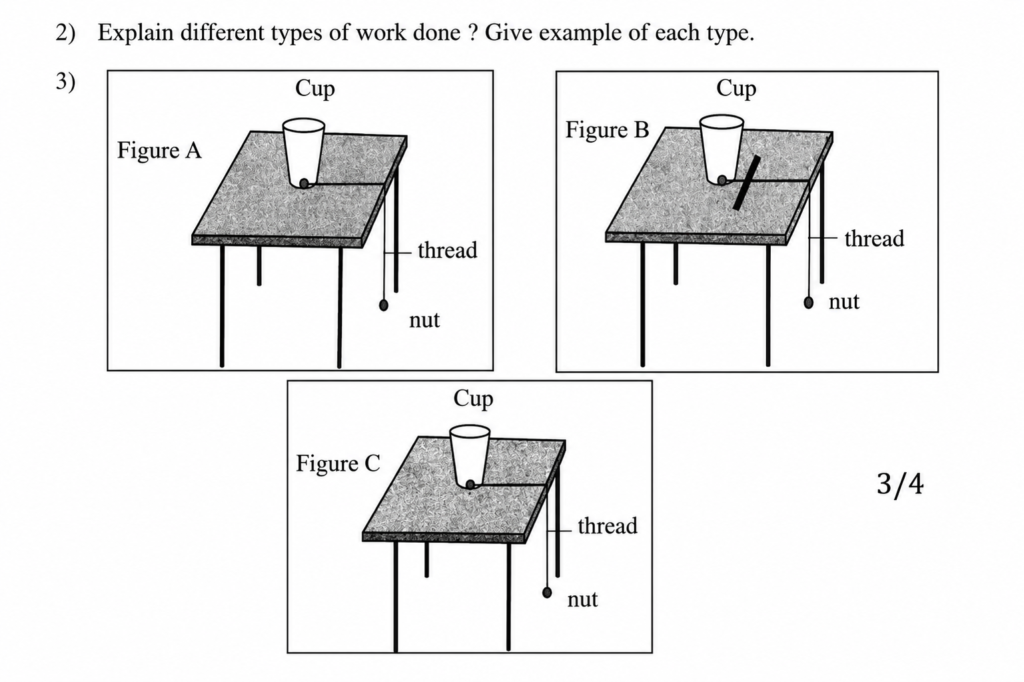
-
Observe the figure above and answer the question.
- Why does the cup get pulled in figure (A) ?
- Why doesn’t the cup get displaced in figure (C) ?
- What is the type of work done in figures A, B, and C ?
- 4) Write the precautions to be taken while using electricity.
-
5) Complete the relationship between joule and erg.
1 newton = dyne
and 1 m = cm
work = force ×
1 Joule = × 1m
1 Joule = ×
= 107 dyne cm
- 6) Explain the term valency with suitable examples.
-
7) Complete the following feactions.
- a) HNO3 + → KNO3 +
- b) Mg(s) + 2HCl(aq) → +
- c) CaO(s) + → + H2O
-
8) Write the steps in deduce the chemical formulae of the following compounds.
- Calcium carbonate
- Sodium bicarbonate
- Silver chloride
| 4. Solve the following questions (Any One) |
-
1) The following figure shows the symbols for components used in electrical circuit.
Place them at proper places and complete the circuit.
- Which law can you prove with the help of the above Circuite ? Write the use of any four components.
-
2) Following are atomic masses of a few elements in Daltons. and the molecular formular of some compounds. Write the name of the given compounds and find molecular masses of compounds.
( H = 1, O = 16, S = 32, Na = 23 )
- a) H2SO4
- b) NaOH
PDHMA Question Paper 9th Class: First Semester Examination 2022-23 Science & Technology – 1
Class 9 Science & Technology – 1 first semester preparation guide covering important concepts, question practice, MCQs, revision methods and examination strategy.
PDHMA Question Paper 9th Class First Semester Examination 2022-23
The PDHMA Question Paper 9th Class First Semester Examination 2022-23 Science & Technology – 1 is a useful topic for students searching for previous examination material and practice resources for Class 9 Science.
Science & Technology – 1 requires students to develop conceptual understanding along with the ability to solve different forms of questions. A student may be asked to identify a scientific principle, explain a process, interpret information, solve a numerical problem or select the correct option in an objective question.
Working with an older examination paper can help students understand how they perform when questions are presented without the support of textbook notes. It also provides an opportunity to discover topics that require additional revision.
The best preparation approach combines textbook study, classroom notes, chapter exercises, scientific diagrams, numerical practice and previous-year question solving.
Science & Technology – 1 Preparation
Begin with the chapters included in the applicable first-semester syllabus. Understand each concept, prepare short notes and then use question papers for self-assessment.
About Class 9 Science & Technology – 1
Science & Technology – 1 contains scientific concepts that require both understanding and application. Students should become comfortable with definitions, laws, processes, observations, calculations and scientific reasoning.
The first semester should be studied chapter by chapter. Instead of trying to memorise an entire textbook at once, divide the material into smaller sections and revise them at regular intervals.
When learning a scientific principle, ask yourself what it means, why it works and where it can be applied. This approach helps when the examination uses unfamiliar wording.
After completing each chapter, solve its exercise questions. Once several chapters have been revised, attempt a previous-year paper to check your overall preparation.
PDHMA 9th Science & Technology – 1 Paper Details
| Particular | Details |
|---|---|
| Class | 9th Class |
| Subject | Science & Technology – 1 |
| Examination | First Semester Examination |
| Academic Session | 2022-23 |
| Resource Type | Previous-Year Question Paper Practice |
| Main Purpose | Revision, Practice and Self-Assessment |
| Preparation Focus | Concepts, Numericals, Diagrams and Scientific Reasoning |
Why Solve the 2022-23 Science & Technology – 1 Paper?
A previous-year paper provides a practical way to combine knowledge from different chapters. Students can discover whether they can recall concepts without referring to their notes.
🔬 Concept Review
Questions can reveal whether important scientific principles have been understood properly.
📘 Chapter Coverage
A full paper brings multiple topics together and helps students assess their overall preparation.
🧮 Numerical Practice
Science papers may require students to apply formulas and present calculations clearly.
📐 Diagram Skills
Where diagrams are required, regular practice improves accuracy and labelling.
🎯 Error Detection
Incorrect answers can identify concepts that need another round of study.
⏱ Exam Readiness
Timed practice helps students become more comfortable with completing a paper within the available period.
How to Prepare for First Semester Science
Start preparation by checking the chapters included in the first-semester syllabus. Make a chapter list and divide the available study time between reading, problem solving and revision.
Read the Textbook Thoroughly
Read each prescribed lesson carefully. Pay attention to definitions, examples, activities, scientific statements and diagrams.
Understand the Principle
When you encounter a scientific law or process, understand the relationship between the different quantities or factors involved.
Create Revision Notes
Write short notes containing formulas, definitions, important observations, processes and other useful information from the chapter.
Practise Numerical Problems
For numerical topics, solve multiple examples and write the formula, values, calculation and final answer in a clear sequence.
Attempt Previous Questions
After completing chapter revision, solve previous-year questions without opening your notes.
Key Study Areas for Science & Technology – 1
Scientific Laws and Principles
Understand the meaning of important laws and learn how they are applied to scientific situations.
Numerical Problems
Practise calculations related to the topics included in the applicable syllabus. Always check the units and final result.
Definitions
Revise important scientific terms and learn to explain them accurately.
Diagrams
Practise important scientific diagrams and make sure the labels are placed correctly.
Reasoning Questions
Prepare explanations for questions that ask why a particular scientific phenomenon occurs.
Application-Based Problems
Learn to apply scientific knowledge to situations rather than relying only on memorised textbook sentences.
How to Approach Numerical Questions
Numerical questions should be solved systematically. First identify the information given in the question and determine what needs to be calculated.
Next, select the appropriate formula or scientific relationship. Substitute the values carefully and perform the calculation step by step.
Write the correct unit with the final answer whenever the question requires one.
Before moving to the next question, check whether the final value is reasonable. A quick review can help identify arithmetic or substitution mistakes.
Given Information → Required Quantity → Formula → Substitution → Calculation → Unit.
How to Prepare Scientific Diagrams
Diagrams can be an effective way of presenting scientific structures and processes. Students should practise important figures from the current syllabus.
Draw the main structure first and then add the required labels. Labels should be clear and should point to the correct components.
Do not wait until the examination week to practise diagrams. Repeated drawing makes it easier to reproduce them accurately.
Understanding the function of each labelled part is equally important because questions may ask students to identify or explain a component.
How to Solve Science Reason-Based Questions
Questions asking for a reason require more than a simple statement. Students should identify the scientific principle responsible for the observation.
Read the complete question first and identify the event being discussed. Recall the relevant concept and then connect it directly to the observation.
Avoid giving unrelated facts. A concise scientific explanation is generally more effective than a long response containing unnecessary information.
Different Question Types to Practise
Objective Questions
MCQs can test definitions, scientific facts, relationships and applications. Careful reading is important because small wording differences can change the correct option.
Very Short Answers
These questions usually require a precise fact, term, formula or identification. Keep the response focused.
Short Explanations
Explain the requested concept using the relevant scientific terms and supporting points.
Long Responses
Organise longer answers into logical steps or points. Include all major elements required by the question.
Numericals
Show the necessary calculation and include appropriate units.
Diagram Questions
Practise drawing, identifying and labelling important figures from the prescribed syllabus.
Science & Technology – 1 Practice MCQs
The following questions are original practice MCQs created for Class 9 revision. They are not presented as exact questions from the 2022-23 examination paper.
How to Use These MCQs
Attempt every question without looking at the answer section. Write your choices separately and calculate your score after completing the set.
For every wrong response, identify the underlying concept. Open the relevant textbook section and study the explanation again.
Avoid memorising only the option letter. Understanding why the correct answer is right will make you better prepared for differently worded questions.
You can also create your own MCQs from important definitions and concepts after completing each chapter.
How to Improve Numerical Problem Solving
Numerical questions become easier when students follow the same logical sequence every time. Begin by writing down the known quantities.
Identify the unknown quantity and select the relevant formula. Substitute the values carefully and perform the calculation.
Check whether the units are consistent. If a conversion is required, complete it before applying the formula.
Finally, write the answer clearly with the appropriate unit and review the calculation for arithmetic errors.
How to Improve Science Answer Writing
Science answers should communicate the required concept clearly. Use the correct terminology and avoid vague statements.
When a question asks for several points, present them separately. For a process, explain the sequence in the correct order.
When giving a reason, mention the scientific principle responsible for the observation.
For numerical problems, include the relevant working rather than writing only the final number.
For diagrams, maintain clear labels and avoid unnecessary marks.
Common Mistakes in Science Examinations
Memorising Without Understanding
Students sometimes learn answers word for word but struggle when the question is presented differently. Conceptual learning reduces this problem.
Skipping Numericals
Reading formulas is not enough. Numerical problems require repeated practice.
Ignoring Units
A numerical answer can be incomplete if the required unit is missing or incorrect.
Unclear Diagrams
Poor labelling can make an otherwise correct diagram difficult to evaluate.
Writing Too Much
A longer answer is not necessarily a better answer. Focus on the information requested.
Not Reviewing Errors
Practice becomes more effective when mistakes are analysed and corrected.
How to Analyse the 2022-23 Practice Paper
Once the paper has been completed, divide your mistakes into categories. Separate conceptual errors from calculation mistakes and careless errors.
If a particular chapter produces several incorrect responses, give that topic extra revision time.
For numerical errors, repeat similar calculations. For conceptual problems, return to the textbook explanation.
Keep a small error notebook and review it before the next practice test.
Attempt → Check → Find Weak Topic → Revise → Solve Similar Questions.
Seven-Day Science Revision Plan
Day 1
Revise the first group of chapters and prepare concise notes containing important concepts and definitions.
Day 2
Work on numerical topics and practise calculations from the textbook.
Day 3
Review diagrams, scientific processes and reason-based questions.
Day 4
Attempt objective questions covering the first-semester syllabus.
Day 5
Solve selected previous-year questions without referring to notes.
Day 6
Attempt a complete practice paper under examination-style conditions.
Day 7
Analyse mistakes and revise the concepts that caused difficulty.
Time Management During the Examination
Students should understand the structure of their current examination before deciding how much time to spend on each section.
Read every question carefully, but avoid spending too long on a single problem. If the paper permits, move ahead and return to difficult questions later.
Numerical problems should receive enough time for calculation and checking. Rushing through them can create avoidable errors.
Keep some time at the end for reviewing unanswered questions, units, calculations and diagrams.
Role of Textbook Revision
The prescribed textbook should remain the foundation of preparation. Previous-year questions are useful, but they cannot replace systematic study of the syllabus.
Read explanations carefully and pay attention to examples and activities. Many concepts become easier when connected with practical observations.
After finishing a chapter, close the textbook and try to explain its main ideas from memory. This active recall technique can reveal areas that require more revision.
Frequently Asked Questions
What is the PDHMA 9th Class First Semester Science & Technology – 1 paper?
It refers to Science & Technology – 1 examination material associated with the Class 9 First Semester Examination for the 2022-23 academic session.
How can I use a previous-year paper?
Complete it independently after studying the relevant chapters and then analyse your mistakes to identify weak areas.
Are the MCQs on this page copied from the 2022-23 paper?
No. The MCQs provided here are original practice questions created for revision.
How should I prepare for numerical questions?
Learn the relevant formulas, understand the quantities involved and solve multiple examples while checking units and calculations.
Should I practise diagrams?
Yes, wherever diagrams are included in your current syllabus. Practise both drawing and labelling them correctly.
How can I improve my Science marks?
Build conceptual understanding, revise the textbook, practise numericals, solve objective questions and analyse errors after every test.
Is the 2022-23 pattern automatically valid for a current exam?
Not necessarily. Students should check the syllabus and examination pattern applicable to their current academic year.
Why is mistake analysis important?
It shows whether an incorrect answer resulted from lack of knowledge, misunderstanding, calculation problems or careless reading.
Conclusion
The PDHMA Question Paper 9th Class: First Semester Examination 2022-23 Science & Technology – 1 can be used as a supplementary practice resource for Class 9 students. Previous-year question solving gives learners an opportunity to test their understanding across multiple areas of Science & Technology.
Strong preparation should combine textbook learning with practical question solving. Students should revise scientific concepts, practise numerical problems, learn important terminology and work on diagrams included in their course.
The MCQs in this article provide additional objective practice. Students can use them to check their basic understanding and identify topics that need further study.
A useful preparation cycle is: Understand → Practise → Check → Analyse → Revise → Attempt Again.
Students preparing for an examination in another academic year should compare the older paper with their current syllabus and examination requirements before using it as their main practice resource.