| Notes :- | 1) | All questions are compulsory. |
| 2) | Draw neat diagrams with pencil. |
| 1. A) Answer the following questions. | 5 |
- 1) Who am I ? I am ATP producing factory.
- 2) Give functions of cellwall.
-
3) Find the odd one out.
Blood group – A, B, AB, O, K
-
4) State whether the following statements are true or false
Oxides of metals are alkaline in nature.
-
5) Fill in the blank.
Rusting of iron is a ____________ a chemical change.
| B) Rewrite the following statements by slecting the correct options. | 5 |
-
1) – 273.15 °C is equal to ____________ kelvin
a) 0 b) 1 c) 273 d) 2 -
2) The region in a sound wave with higher pressure and density is called…………
a) rarefraction b) compression c) both a and b d) not any -
3) The angle of incidence made an equal angle with ____________ angle.
a) reflection b) incidence c) not any -
4) What is PVC ?
a) Polyvinyl chlorid b) Polysfyrene c) Bakelite d) Melamine -
5) Air, water, minerals, soil are………… factors of an ecosystem.
a) abiotic b) biotic c) chemical d) Physical
| Answer the following questions. (Any Six) | 12 |
- 1) Name two forces that act on any star.
- 2) What are uses of PVC ?
- 3) If the angle of incidence is 45° then what will he the angle of refection ?
Give reasion.
-
- 4) Convert 20 °C in degree Fahrenheit.
- 5) Why plants in an ecosystem are called producers ?
- 6) Give reason – Plant in a ecosystem are called producers.
- 7) Which substances are produced by neutralization process ?
- 8) Why did Asian Cheetah become extinct in last century.
| 3. Answer the following questions. (Any Six) | 18 |
- 1) Distinguish between the prokaryotic and Eukaryotic cell.
- 2) Different between – Man made material and Natural material.
- 3) Distinguish between Acid and base.
- 4) Give properties of plastic.
-
5) Match the pairs.
‘A’ group ‘B’ group i) Human larynx a) Vibrations of metal grous. ii) Tuning fork b) Vibrations in vocal cords iii) Star d) Vibrations in stings - 6) Draw neat and labelled diagram of Reflection of light.
- 7) short note on : Production of glass.
- 8) What are the effects of increased population on ecosystems ?
| 4. A) Answer the following questions. (Any Two) | 8 |
- 1) Draw the structur of plant cell & animal cell & Write the difference between them.
-
2) Explain the circulatory system with the following points.
- i) arteries
- ii) veins
- iii) capillaries
- iv) blood circulation through heart
- 3) How do stars form ?
-
4) Write the formulae for the following expansion.
- a) Linear expansion
- b) Areal expansion of solids
- c) Volumetric expansion of solids.
| B) Solve the following example. | 2 |
- 1) When a substance having mass 3kg, receives 600 cal of heat its temp. increars from 10 °C to 70 °C. Than what is the specific heat of the substance ?
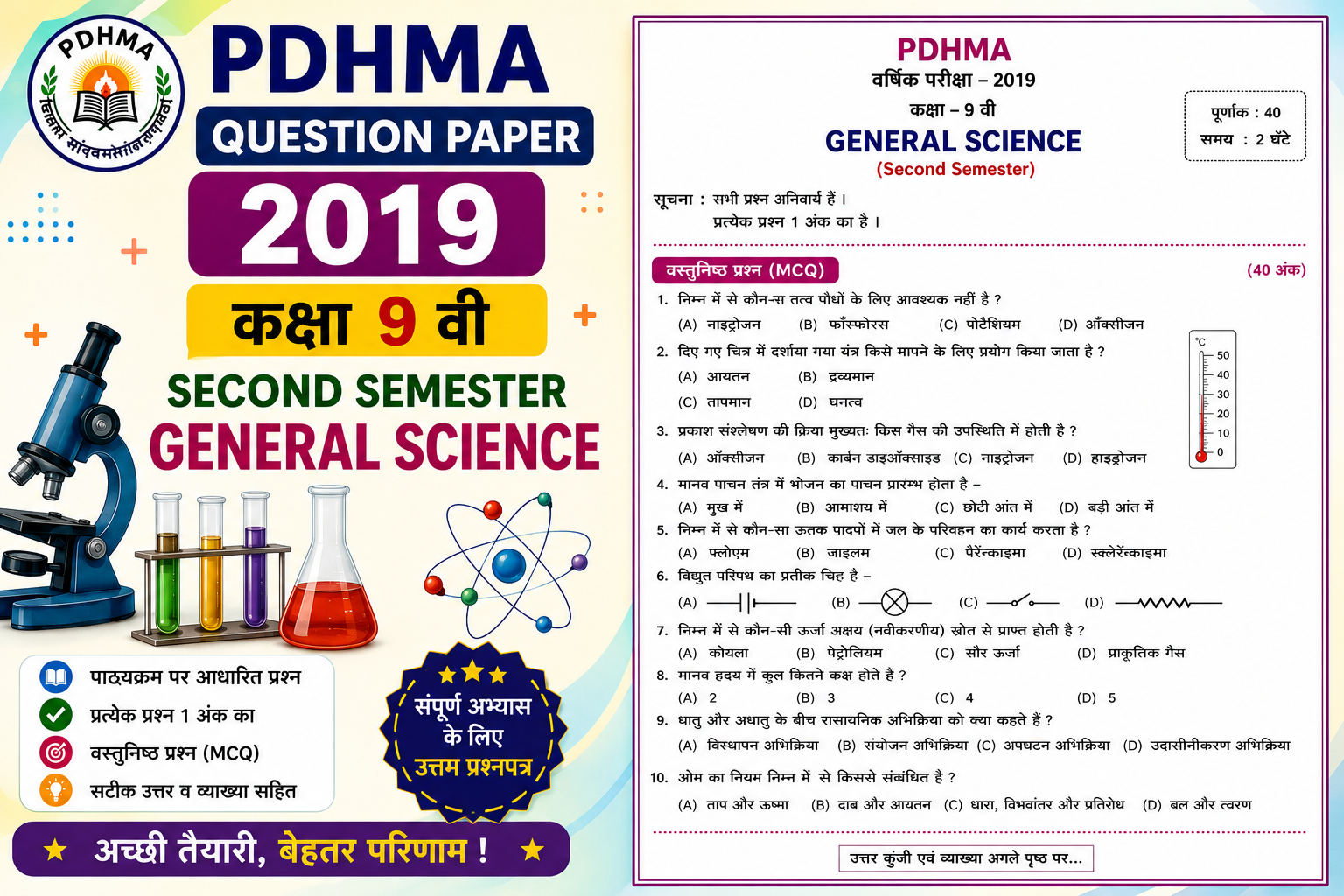
PDHMA Question Paper 2019 9th: Second Semester General Science
Class 9 General Science Second Semester previous-year paper preparation, chapter revision, objective practice, scientific concepts and examination strategy.
PDHMA Question Paper 2019 9th Second Semester General Science
The PDHMA Question Paper 2019 9th Second Semester General Science is a useful resource for students searching for Class 9 General Science examination material from the second semester. Science preparation requires students to understand concepts, remember important terminology, interpret scientific information and apply knowledge to questions.
A previous-year question paper gives students an opportunity to practise questions in an examination-oriented format. Instead of simply reading chapters, students have to recall information and construct answers on their own.
The PDHMA 9th General Science Second Semester Question Paper can be used during revision after students have completed the relevant chapters. It is particularly useful for identifying topics that need another round of study.
General Science Second Semester Preparation
A balanced preparation method should include textbook reading, concept understanding, diagrams where applicable, numerical practice, short answers, objective questions and full-paper revision.
About the 9th Class Second Semester General Science Paper
General Science combines different branches of scientific knowledge. Students may need to understand physical processes, chemical concepts, biological systems, environmental relationships and scientific applications depending on the prescribed curriculum.
Second-semester preparation should begin by identifying the chapters included in the relevant course. Once the chapters are listed, students can divide them into smaller study units and revise each unit systematically.
The main objective should be conceptual understanding. When students understand why a process occurs, they can often answer questions even when the wording is different from the textbook.
Previous-year questions can then be used to test whether that understanding can be applied under examination conditions.
PDHMA 9th General Science Paper – Basic Details
| Particular | Details |
|---|---|
| Subject | General Science |
| Class | 9th Class |
| Semester | Second Semester |
| Question Paper Year | 2019 |
| Resource Type | Previous-Year Examination Practice |
| Main Use | Revision and Self-Assessment |
| Study Method | Concept Learning + Question Practice |
Why Practise a Previous-Year General Science Paper?
Previous-year paper solving is useful because it turns revision into an active exercise. Students have to recall information instead of simply recognising it on a textbook page.
🔬 Concept Testing
Questions help determine whether a student understands the scientific idea behind a topic.
📘 Chapter Revision
A complete paper can bring several chapters together and reveal which sections need additional revision.
📝 Answer Practice
Writing scientific answers regularly helps students present information in a clear and logical manner.
🎯 Mistake Identification
Incorrect responses show where further study or practice may be required.
⏱ Time Planning
Timed paper practice helps students become comfortable with completing different question types within the available period.
💡 Confidence
Repeated practice can make students more familiar with examination-style tasks and reduce uncertainty.
How to Prepare for Second Semester General Science
Begin preparation by collecting the current textbook, syllabus and class notes. List the chapters included in the second semester and divide them into a realistic study plan.
Read the Chapter
Read the textbook carefully and identify definitions, concepts, examples, processes and diagrams that are part of the course.
Understand Scientific Terms
Scientific terminology should be learned with its meaning. Knowing the term without understanding the concept behind it can make application questions difficult.
Prepare Short Notes
Write concise notes containing important facts, relationships, processes and key terms. These notes can be useful during later revision.
Solve Chapter Questions
Complete textbook exercises before moving to previous-year questions. This creates a strong foundation for paper practice.
Attempt a Full Paper
After sufficient preparation, solve the previous-year paper independently. Treat the exercise like a real examination.
Important Areas to Revise
Scientific Definitions
Revise important terms and understand their meanings. Definitions should be written accurately and clearly.
Scientific Processes
Understand the sequence of events involved in important processes. Focus on both the stages and the reason behind them.
Diagrams
Where diagrams are included in the syllabus, practise drawing, labelling and identifying their important parts.
Differences and Comparisons
Prepare comparison-based questions using clear points so that the difference between two concepts is easy to understand.
Reason-Based Questions
Practise questions that ask why a particular scientific event occurs. Focus on the underlying principle rather than memorising one sentence.
Application Questions
Use scientific concepts to explain simple situations and observations.
How to Solve the Second Semester Science Paper
A calm and organised approach can help students use examination time effectively. Every question should be read carefully before writing the answer.
- Read the instructions. Understand the requirements before starting the questions.
- Study the wording. Identify whether the question asks for a definition, explanation, reason, comparison or calculation.
- Recall the relevant concept. Connect the question with the appropriate chapter.
- Write directly. Provide the information needed rather than adding unrelated material.
- Use scientific vocabulary. Correct terminology makes an answer clearer.
- Check diagrams and calculations. Review labels, steps and units where applicable.
- Review unanswered questions. Before finishing, check that every required response has been attempted.
Types of Questions Students Should Practise
Multiple Choice Questions
MCQs test quick recall and understanding. Students should read every option before selecting the most appropriate answer.
One-Line Questions
These require a short and precise response. Avoid unnecessary explanation when the question asks for only a particular fact.
Short Answer Questions
A short-answer response should contain the important points required by the question and use correct scientific terminology.
Long Answer Questions
For descriptive questions, organise the explanation logically. Separate different points where appropriate.
Give-Reason Questions
These questions require the scientific cause behind a particular observation or statement.
Diagram-Based Questions
Students should be able to identify important structures and reproduce required diagrams accurately where included in the syllabus.
General Science Practice MCQs
The following questions are included as original practice MCQs for Class 9 General Science revision. They are not presented as exact questions from the 2019 PDHMA examination.
How to Use the MCQs for Revision
Students should first attempt the questions without looking at the answer boxes. Record the options you choose in a notebook and check them only after completing the set.
For every incorrect response, identify the chapter or concept associated with the question. Return to the textbook and review that section carefully.
Do not memorise the answer letter alone. Understanding the reason behind the correct option makes it easier to solve another question on the same topic.
Students can repeat the exercise after a few days using fresh questions from their textbook or other practice material.
How to Improve Science MCQ Accuracy
Read the Question Completely
A single word can change the meaning of an objective question. Read the full sentence before considering the options.
Compare All Choices
Sometimes two options may look similar. Read both carefully and select the one that best matches the scientific concept.
Use Conceptual Knowledge
Instead of guessing from memory, connect the question with the principle you studied in the textbook.
Eliminate Incorrect Answers
Removing clearly unsuitable options can make the final selection easier.
Review Mistakes
Repeated mistakes in one topic indicate that the concept requires further study.
How to Prepare Diagrams
Diagrams can make scientific concepts easier to understand and may be important in examination preparation when included in the syllabus.
Students should practise drawing diagrams from memory rather than tracing them every time. After completing a drawing, compare it with the textbook and correct missing parts.
Labels should be neat, readable and placed close enough to the relevant structures. Avoid unnecessary decoration in examination diagrams.
Understanding the function of each labelled part is more useful than memorising the visual shape alone.
Preparation for Give-Reason Questions
Reason-based questions test whether students understand cause and effect. A strong answer should mention the relevant scientific principle.
When preparing for such questions, create a list of important observations from each chapter and ask yourself why each observation occurs.
For example, instead of memorising a complete sentence, understand the process that produces the result. This makes it easier to answer when the wording changes.
Preparation for Difference-Based Questions
Comparison questions are easier when students organise information in a structured manner.
Create two-column revision notes for important pairs of concepts. Include differences in definition, characteristics, function, location or other features relevant to the syllabus.
During the examination, make sure that every comparison point actually relates to the two concepts being discussed.
How to Analyse the 2019 General Science Paper
After completing the previous-year paper, do more than calculate your score. Analyse the nature of every mistake.
If you forgot a fact, revise the relevant section. If you misunderstood a concept, read the explanation again and solve additional examples.
For careless errors, identify what caused the mistake. It could be hurried reading, incorrect calculation, missing a unit or misunderstanding the question.
Create a short list of weak topics and revise them before attempting another full-length paper.
Find the Error → Identify the Cause → Revise the Concept → Practise Again.
Common Mistakes in General Science Examinations
Learning Only Definitions
Definitions are important, but students should also understand how concepts work and where they are applied.
Skipping Difficult Chapters
Avoiding a challenging topic can create problems during the examination. Break difficult material into smaller sections and study them gradually.
Ignoring Diagrams
If diagrams are part of the syllabus, they should receive regular revision instead of being left until the final day.
Not Checking Units
Numerical answers should be reviewed for appropriate units whenever the question requires them.
Writing Unrelated Information
A scientific answer should remain connected to the question. Extra information does not automatically improve an answer.
Skipping Final Review
A final check can reveal unanswered questions, spelling errors, missing labels and calculation mistakes.
Time Management for the Second Semester Paper
Students should practise dividing examination time among different question types. The exact distribution depends on the applicable paper pattern.
Start with questions you can answer confidently if the examination format allows flexible movement between questions. This can help prevent one difficult question from consuming too much time.
When a calculation or explanation requires several steps, write the necessary working clearly rather than rushing to the final answer.
Leave a few minutes for checking. Review important numerical responses, diagrams, labels and questions that were marked for later attention.
Seven-Day Revision Strategy
Day 1 – Chapter Review
Read the first group of second-semester chapters and prepare short notes.
Day 2 – Concept Practice
Revise difficult concepts and solve textbook exercises.
Day 3 – Objective Questions
Practise MCQs, definitions and short-answer questions from the completed chapters.
Day 4 – Diagrams and Explanations
Revise diagrams and practise explaining important scientific processes.
Day 5 – Previous-Year Questions
Attempt selected questions from the 2019 paper without using notes.
Day 6 – Full Paper Practice
Complete a full practice paper under suitable examination conditions.
Day 7 – Mistake Revision
Review errors from the practice paper and revise the concepts that caused difficulty.
How Parents Can Support Science Preparation
Parents can help students establish a consistent study routine and provide a suitable environment for revision.
Rather than immediately giving an answer, encourage the student to return to the textbook and attempt the question again. This develops independent study habits.
Parents can also ask students to explain a scientific concept in simple words. If the explanation is clear, it usually indicates a stronger level of understanding.
Practice-test results should be viewed as feedback. Mistakes provide useful information about which areas need improvement.
How Teachers Can Use Previous-Year Questions
Teachers can use selected previous-year questions for classroom revision. After discussing the solution, they can create fresh questions based on the same scientific concept.
MCQs can be used as quick warm-up exercises at the beginning of a lesson. Students can first answer independently and then discuss the reasoning.
Teachers may also ask students to identify why an incorrect option is wrong. This encourages conceptual understanding instead of simple answer memorisation.
Frequently Asked Questions
What is the PDHMA Question Paper 2019 9th Second Semester General Science?
It refers to Class 9 General Science examination material associated with the second semester and the 2019 examination period.
Why should students practise an old General Science paper?
It can help with revision, question-solving ability, time management and identification of weak concepts.
Are the MCQs on this page from the original 2019 paper?
No. They are original practice questions created for Class 9 General Science revision.
Can students prepare only from the previous-year paper?
Students should use the current syllabus and prescribed textbook as their primary resources. The old paper is best used for additional practice.
How can I improve my General Science score?
Focus on conceptual understanding, textbook exercises, diagrams, objective questions, written answers and regular mistake analysis.
How should I prepare for diagrams?
Practise important diagrams from the current syllabus, learn the function of each part and work on accurate labelling.
How can I improve MCQ performance?
Understand concepts, read every question carefully, compare all options and analyse incorrect answers after practice.
Is the current syllabus important when using a 2019 paper?
Yes. An older paper may not contain exactly the same topics or pattern as a current examination, so current syllabus requirements should guide preparation.
Should I solve the complete paper in one sitting?
Once the relevant chapters have been studied, solving the complete paper in one sitting can provide useful examination practice.
Conclusion
The PDHMA Question Paper 2019 9th: Second Semester General Science can be used as a supplementary revision resource for Class 9 students. Previous-year paper practice helps students test their understanding, improve answer-writing skills and discover topics that need additional attention.
A successful Science preparation strategy should not depend on memorising previous questions. Students should understand scientific concepts, revise important terminology, practise diagrams where required and solve different types of questions.
The MCQs included in this article provide an additional opportunity to check basic knowledge and improve objective-question accuracy. Students should use wrong answers as signals for further revision rather than simply memorising the correct option.
Regular study combined with chapter exercises, previous-year questions, objective practice and mistake analysis can make second-semester preparation more organised.
The recommended study cycle is: Study → Understand → Practise → Check → Correct → Revise.
Students preparing for a current examination should always compare the older 2019 material with the syllabus and requirements applicable to their present academic year.