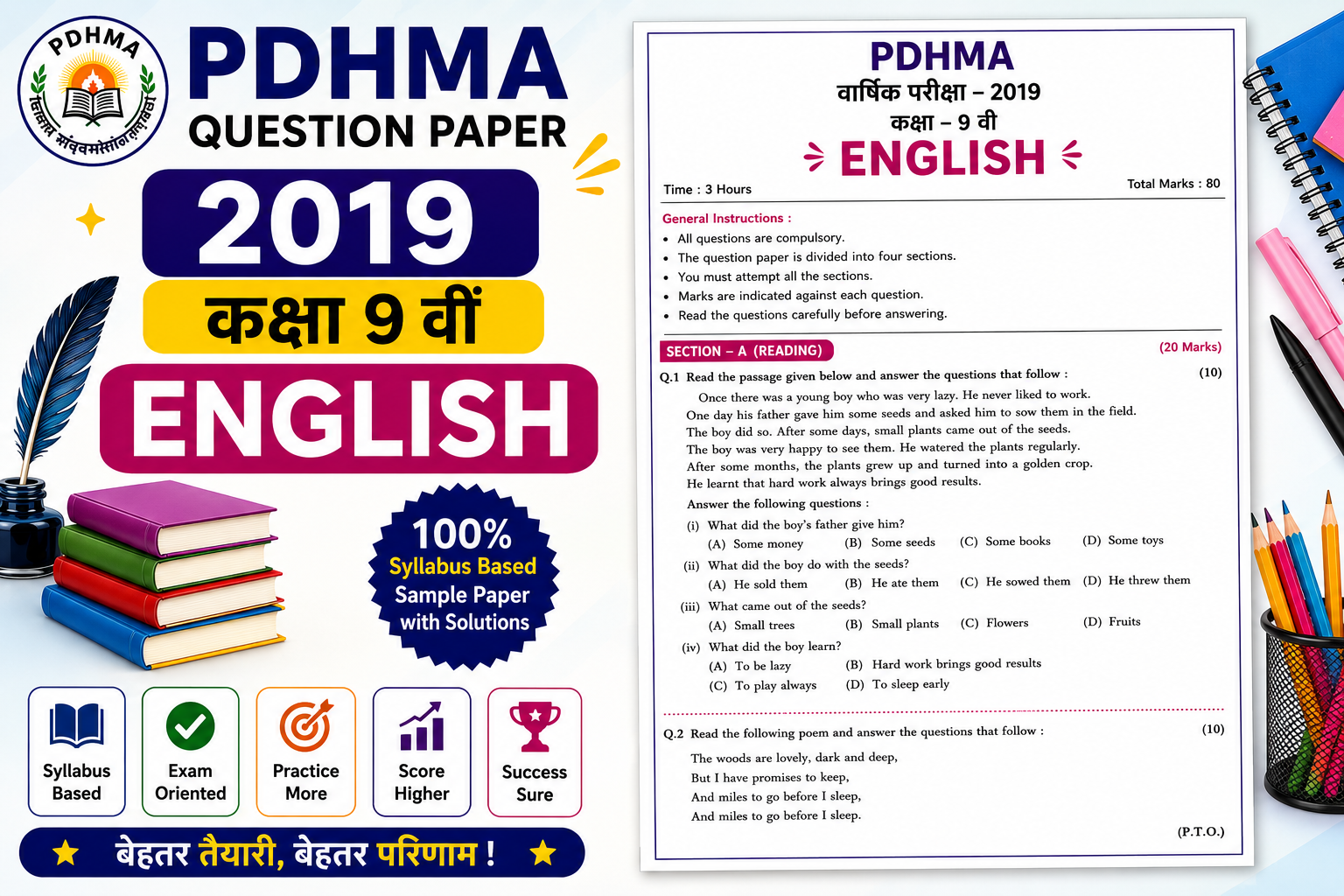
pdhma question paper 2019 9th:english paper

The PDHMA Question Paper 2019 9th: English Paper is an excellent study resource for Class 9 students aiming to strengthen their exam preparation. By practicing this paper, students can gain a clear understanding of the exam pattern, frequently asked questions, and the marking scheme. Regular practice with the PDHMA Question Paper 2019 9th: English Paper helps build confidence, improve time management, and enhance overall performance. Download it now to boost your preparation and achieve better results in your examination.

First Semester Examination – English
PDHMA
Std – IX
Time – 3.00 Hrs.
First Semester Examination 2019 – 20
Sub – English
Marks – 80
Pages – 8
Section-1 Language Study
1. A) Do as directed. (Attempt any four) 10
8
  • 1) Complete the words by using correct letters.
    i) st_ry ii) no_el iii) lec_ure iv) to_r
    2
  • 2) Put the words in alphabetical order.
    • enter, barber, shop, local
    • sign, some, sigh, smooth
    2
  • 3) Punctuate the following.
    • you have chosen a good time to come he declared
    • just my luck said twain with a sigh
    2
  • 4) Make four words (minimum 3 letters) using the letters in the word ‘Imperialism’.
    2
  • 5) Write the related words as shown in the example.
    Popular drink
    2
  • 6) Complete the words chain of ‘Nouns’. Add four words each beginning with the last letters of the previous word.
    Friend 1) ………… → 2) ………… → 3) ………… → 4) …………
    2
B) Do as directed. 2
  • 1) (Attempt any one)
    • Make meaningful sentence by using the phrase ‘to take over’.
    — OR —
    English Question Paper – Page 2
    Margie was hurt. “Well, I don’t know what kind of school they had all that time ago.” She read the book over his shoulder for a while, then said, “Anyway, they had a teacher.”
    “Sure they had a teacher, but it wasn’t a regular teacher. It was a man.”
    “A man? How could a man be a teacher?”
    “Well, he just told the boys and girls things and gave them homework and asked them questions.”
    “A man isn’t smart enough.”
    “Sure he is. My father knows as much as my teacher.”
    “He knows almost as much, I betcha.”
    Margie wasn’t prepared to dispute that. She said, “I wouldn’t want a strange man in my house to teach me.”
    Tommy screamed with laughter. “You don’t know much, Margie. The teachers didn’t live in the house. They had a special building and all the kids went there.”
    “And all the kids learned the same things?”
    “Sure, if they were the same age.”
    “But my mother says a teacher has to be adjusted to fit the mind of each boy and girl it teaches and that each kid has to be taught differently.”
    • A2 Complete the following Table of who said ? To Whom ? 2
      Statements Who said ? To Whom ?
      a) “How could a man be a teacher ?” …………………… ……………………
      b) “My father knows as much as my teacher.” …………………… ……………………
    • A3 Fill the words in column A with their contracted forms in column B 2
      Column A Column B
      1) …………………… a) don’t
      2) …………………… b) wouldn’t
      3) I will c) ……………………
      4) You are d) ……………………
    • A4 Underline the verbs in following sentences and choose the correct option from the brackets. 2
      • i) They were the same age (Singular / Plural.)
      • ii) My mother says a teacher has to be adjusted to fit the mind of each boy and girl
            (Singular / Plural)
    • A5 Personal Response : 2
      How would you like to learn, from a human teacher or a mechanical teacher ? Why ?
    English Question Paper – Page 3
    B) Read the following passage and do the activities. 10
    • B1 State whether the following sentences are True or False. 2
      • i) The day was very eventful. …………
      • ii) Helen did not learn new words that day. …………
      • iii) Everything had a name. …………
      • iv) Helen did not try vainly to put them together. …………
    I left the well-house eager to learn. Everything had a name, and each name gave birth to a new thought. As we returned to the house, every object that I touched seemed to quiver with life. That was because I saw everything with the strange, new sight that had come to me. On entering the door I remembered the doll I had broken. I felt my way to the hearth and picked up the pieces. I tried vainly to put them together. Then my eyes filled with tears; for I realised what I had done, and for the first time I felt repentance and sorrow.

    I learned a great many new words that day. I do not remember what they all were; but I do know that mother, father, sister, teacher were among them-words that were to make the world blossom for me “like Aaron’s rod, with flower.” It would have been difficult to find a happier child than I was as I lay in my crib at the close of that eventful day and lived over the joys it had brought me, and for the first time longed for a new day to come.
    • B2 Complete the following web. 2
      New words Helen learned on that day
    • B3 Read the following words and classify them into ‘one’ and ‘many’. 2
      Well-house, doll, Pieces, crib, words, eyes, flower, children
      One Many
      i) ……………………………… a) ………………………………
      ii) ……………………………… b) ………………………………
      iii) ……………………………… c) ………………………………
      iv) ……………………………… d) ………………………………
    • B4 Rewrite the following sentences using ‘Helen Keller/Young Helen’ appropriately in place of ‘I’ and making other necessary changes in the sentences. 2
      • 1) I do not remember what they all were ;
      • 2) Then my eyes filled with tears ; for I realised what I had done,
    • B5 Personal Response. 2
      Complete the following sentences using your own ideas :
      • 1) One day, while I was playing ______________
      • 2) I did not know what ______________
    English Question Paper – Page 4
    Section- III Poetry
    3. A) Read the following stanzas and do the activities. 5
    • A1 Choose the correct option and complete the sentences. 2
      • i) Hope is symbolized as ………………..
        a) bird b) land c) storm
      • ii) Hope demands ………………..
        a) A crumb b) nothing c) sea
      • iii) Who keeps us warm ………………..
        a) Hope b) Gale c) Soul
      • iv) Hope sings ………………..
        a) Tune with words b) popular tune b) tune without words
    ‘Hope’ is the thing with feathers –
    That perches in the soul –
    And sings the tune without the words –
    And never stops – at all –
    And sweetest – in the Gale – is heard –
    And sore must be the storm –
    That could abash the little Bird
    That kept so many warm –
    I’ve heard it in the chillest land –
    And on the strangest Sea –
    Yet – never – in Extremity,
    It asked a crumb – of me
    • A2 Complete the following web diagram 2
      Hope is helpful in
    • A3 Point out the rhyming pairs from above lines. 1
    • B) Appreciation of the poem. 5
      Read the poem and write an appreciation of the poem using the points given below.
      Comparisions
      Fast as a spaceship, slow as a snail,
      Big as a dinosaur, small as a nail,
      Fierce as a tiger, gentle as a lamb.
      Sour as a lemon, sweet as jam.
      Dry as the desert, wet as the sea.
      Square as a house, round as a pea.
      Cool as a cave, warm as toast,
      English Question Paper – Page 5
      Strong as an ox, weak as kitten.
      Hard as a rock, soft as a mitten.
      Dark as a tunnel, light as the moon,
      Night time midnight, day time noon.
      Tall as a giant, short as an elf.
      Crooked as a mountain path, straight as a shelf…..
      The world is full of opposites, so think
      of some yourself !
      ….. Anonymous
      • i) Title – 1/2
      • ii) Poet/Poetess : 1/2
      • iii) Rhyme scheme : 1
      • iv) Figure of speech : 1
      • v) Central Idea : 2
      Section- IV Non Textual passage
      [Reading skill, Vocabulary, Grammar and Summary.]
      4. A) Read the following passage and do the activities. 10
      • A1 Find the correct alternatives. 2
        • i) How many countries does the Sahara Desert cover ?
          a) 21 b) 11 c) 31
        • ii) What is the highest point in the Sahara Desert ?
          a) Mali b) Chad c) Emi Koussi
      Located in North Africa, the Sahara is the largest hot desert in the world. Geographically, the Sahara Desert covers as many as eleven different countries including Egypt, Libya, Tunisia, Algeria, Morocco, Western Sahara, Mauritania, Mali, Niger, Chad and Sudan, with an area of around 9.4 million square kilometers.

      The term ‘Sahara’ has its origin in the Arabic language, meaning ‘desert.’ Predictably, it is one of the most consistently hottest places in the world.

      On the other hand, it can drop below freezing point rapidly at nights. In general, the climate is hot, dry, and windy. While it rarely rains in some parts, there are regions which do not see a drop of rain in years.

      All this makes Sahara an inhospitable place to live. It is estimated that only less than 2.5 million people live in the region, despite its vastness.

      The highest point in the desert is the volcano named Emi Koussi in Chad. Historians note that thousands of years ago, the Sahara Desert had enough water to let people live well.
      English Question Paper – Page 5
      Strong as an ox, weak as kitten.
      Hard as a rock, soft as a mitten.
      Dark as a tunnel, light as the moon,
      Night time midnight, day time noon.
      Tall as a giant, short as an elf.
      Crooked as a mountain path, straight as a shelf…..
      The world is full of opposites, so think
      of some yourself !
      ….. Anonymous
      • i) Title – 1/2
      • ii) Poet/Poetess : 1/2
      • iii) Rhyme scheme : 1
      • iv) Figure of speech : 1
      • v) Central Idea : 2
      Section- IV Non Textual passage
      [Reading skill, Vocabulary, Grammar and Summary.]
      4. A) Read the following passage and do the activities. 10
      • A1 Find the correct alternatives. 2
        • i) How many countries does the Sahara Desert cover ?
          a) 21 b) 11 c) 31
        • ii) What is the highest point in the Sahara Desert ?
          a) Mali b) Chad c) Emi Koussi
      Located in North Africa, the Sahara is the largest hot desert in the world. Geographically, the Sahara Desert covers as many as eleven different countries including Egypt, Libya, Tunisia, Algeria, Morocco, Western Sahara, Mauritania, Mali, Niger, Chad and Sudan, with an area of around 9.4 million square kilometers.

      The term ‘Sahara’ has its origin in the Arabic language, meaning ‘desert.’ Predictably, it is one of the most consistently hottest places in the world.

      On the other hand, it can drop below freezing point rapidly at nights. In general, the climate is hot, dry, and windy. While it rarely rains in some parts, there are regions which do not see a drop of rain in years.

      All this makes Sahara an inhospitable place to live. It is estimated that only less than 2.5 million people live in the region, despite its vastness.

      The highest point in the desert is the volcano named Emi Koussi in Chad. Historians note that thousands of years ago, the Sahara Desert had enough water to let people live well.
      English Question Paper – Page 7
      • b) Complete the dialogue.
        • A : What makes you happy ?
        • B : ……………………………………………………
        • A : What makes you sad ?
        • B : ……………………………………………………
      • c) Write a dialogue of minimum six meaningful exchanges on ‘Future occupations/Careers.’ 3
      — OR —
      • B2 Speech Writing. 5
        Your school has organized an Elocution competition. You are asked to deliver a speech on Disability: Challenges and necessary facilities. Prepare a speech using the given points.
        ‘Disabilities’ Vision loss and blindness Speech disorders Intellectual disability Hearing loss and deafness learning disorder Physical disability
      6. A) Information Transfer. 5
      A1 or A2 Do any one of the following :
      • A1 Non verbal to Verbal.
        • Do any one of the following activities.
        • Given below is a web diagram containing information about a dream vehicle. Write a short paragraph based on information from the web. Give a suitable title to it.
        Dream Vehicle Colour use Price Origin or brand Information Transfer – Road Map
        A2 Read the following paragraph about “How I go to my school.” Now draw complete the Road map given below. Fill the names of land marks in blank boxes. No. 1 is Home and No 12 is school. Give a suitable title. 5
        I go to school every day on foot. My school is not very far from my house. I start at 9.30 am and go straight till Samrat Mini Market and turn right, I go straight till Bank of India and turn right. I walk some distance and turn left from Hotel Ashoka, here I meet my friend we go together and turn left from Washing center, again we have to turn left from Civil Hospital, when we reach Ritu’s Hair dressers we take right turn, we have to walk very short distance and turn left from Florist shop, we take right turn and reach Vegetable Market, here we take right turn and walk straight till Green Bakery and turn left. We have to go straight towards Corner Mobile shop. We turn left and walk straight till we reach our destination at 10 am.
        1. HOME 2. ……………………. 3. ……………………. 4. ……………………. 5. ……………………. 6. ……………………. 7. ……………………. 8. ……………………. 9. ……………………. 10. ……………………. 11. ……………………. 12. SCHOOL
        English Question Paper – Page 8
        1 2 3 4 5 6 7 8 9 10 11 12
        B) Expand the theme : B1 or B2 Do any one of the following activities. 5
        • B1 Write a news report based on the given Headlines.
          “Honesty Shines Bright : Student returns Dimond Necklace found on Roadside !”
          Make use of the following guidelines.
          • Headline • Date line
          • Introduction • Short Paragraph
          • Conclusion
        — OR —
        • B2 Developing a Story.
          Develop a story with the help of given beginning. Give a suitable title to your story.
          Sudha was 20 years old. She was a classical dancer. She had decided to become a professional dancer in future. One day when she was travelling she met an accident. One of her leg was badly injured. The doctor decided to cut the leg. ……………………………………………………………………………………..
        SECTION VI : SKILL DEVELOPMENT
        7. Translation 5
        • A) Translate the following words into your medium of instruction : (any Four) 2
          1) Maid 2) borrow 3) disaster
          4) meditation 5) lotus 6) ginger
        • B) Translate the following sentences into your medium of instruction: (Any Two) 2
          • 1) My ornament was an imitation.
          • 2) You must have made a mistake.
          • 3) I worked very hard to pay the debt.
          • English Question Paper – Section 7C
            C) Translate the following idiom/ Proverb into your medium of instruction: (Any One)
            1) Books are our best teachers. 2) Life is a precious gift.
            PDHMA Question Paper 2019 9th: English Paper

            PDHMA Question Paper 2019 9th: English Paper

            Class 9 English previous-year paper preparation guide with grammar revision, reading comprehension, writing skills, literature practice, vocabulary and objective questions.

            PDHMA Question Paper 2019 9th English Paper

            The PDHMA Question Paper 2019 9th English Paper is a useful search topic for students looking for Class 9 English examination material from 2019. English requires a combination of language knowledge and practical skills, so students benefit from reading passages, studying grammar, improving vocabulary and practising written responses.

            A previous-year paper gives learners an opportunity to test their preparation under examination-style conditions. Instead of reading answers from a book, students have to understand the question and construct their own response. This makes paper-solving an effective part of revision.

            The PDHMA 9th English Question Paper 2019 can be used as a supplementary resource after studying the applicable lessons and language topics. Students should compare an older paper with the current syllabus before using it for a present examination.

            About the 9th Class English Paper

            Class 9 English preparation normally involves several connected areas. Reading helps students understand passages, grammar supports accurate sentence construction, vocabulary improves comprehension and writing activities develop communication skills.

            Literature is another major component of English learning. Students need to understand stories, poems, characters, themes, important events and the ideas expressed by authors. Simply memorising prepared answers may not be sufficient when a question is presented in a new way.

            Previous-year questions can help students discover whether they can apply their knowledge independently. A student may understand a chapter while reading it but find it difficult to write an answer without looking at notes. Practice papers help identify this difference.

            For better results, students should combine paper practice with textbook study, grammar exercises, reading activities and regular writing.

            PDHMA Question Paper 2019 9th English – Basic Details

            Particular Details
            Subject English
            Class 9th Class
            Question Paper Year 2019
            Resource Type Previous-Year Examination Paper
            Preparation Use Practice and Self-Assessment
            Main Skills Reading, Grammar, Vocabulary, Literature and Writing
            Suitable For Students, Teachers and Parents
            Note:

            Exact marks, sections and question distribution should be checked against the original examination material. The current syllabus should be treated as the main source for present preparation.

            Why Practise the PDHMA 9th English Paper?

            Solving a previous-year English paper allows students to move beyond textbook reading and test their ability to use the language. It can also reveal which skills require more attention.

            📖 Reading Development

            Regular passage practice can improve the ability to understand information, identify important details and interpret questions correctly.

            🔤 Grammar Improvement

            Written exercises help learners identify common grammar errors and become more comfortable with correct sentence patterns.

            ✍️ Better Writing

            Answer-writing practice encourages students to communicate their ideas with better organisation and clarity.

            📚 Literature Revision

            Questions based on prose and poetry can be used to revise themes, characters, events, meanings and important ideas.

            🧠 Vocabulary Building

            Encountering words in different contexts helps students expand their usable English vocabulary.

            ⏰ Examination Practice

            Completing a paper within a planned period helps students develop a practical approach to time management.

            How to Prepare for Class 9 English

            English preparation should be continuous rather than limited to the days immediately before an examination. A small amount of reading and writing every day can produce better results than irregular long study sessions.

            Read the Prescribed Lessons

            Begin with the textbook. Read prose lessons carefully and identify the central idea, important events, characters and significant details.

            After reading a lesson, try to explain its content without opening the book. This exercise can reveal whether you have actually understood the material.

            Study Poetry Carefully

            For poetry, focus on the meaning, central thought, important expressions and literary elements required by the syllabus.

            Practise Grammar

            Grammar improves through repeated application. Learn the rule and immediately follow it with several examples.

            Read English Regularly

            Reading short articles, stories and age-appropriate English passages can help students become more familiar with sentence structures and vocabulary.

            Write Frequently

            Writing paragraphs, answers and other prescribed formats can improve both accuracy and confidence.

            Important Areas for 9th English Preparation

            Reading Comprehension

            Students should practise understanding both the main message and specific details of an unseen passage. Answers should be based on the information provided rather than unsupported assumptions.

            Grammar

            Revise the grammar topics prescribed for the course and solve varied examples. Pay attention to how grammar works inside complete sentences.

            Vocabulary

            Learn unfamiliar words through context. Record useful words along with their meanings and practise using them in sentences.

            Literature

            Understand the content of prose and poetry instead of relying entirely on memorised answers.

            Writing Skills

            Practise the writing formats required by the current syllabus and concentrate on structure, grammar, clarity and relevance.

            Reading Comprehension Strategy

            Reading comprehension questions test how well a student can understand written information. The best approach is to read the passage carefully before attempting the questions.

            First identify the central subject of the passage. Then notice supporting facts, examples, reasons and important details.

            When answering a question, look back at the relevant portion of the passage. This reduces the chance of selecting an answer based only on memory.

            Students should also pay attention to vocabulary questions. Sometimes the meaning of a word can be understood from the surrounding sentence.

            Useful Reading Habits

            • Read the passage from beginning to end.
            • Identify the central idea.
            • Notice important names, facts and events.
            • Understand the meaning of unfamiliar words from context.
            • Read each question carefully.
            • Answer only what has been asked.

            English Grammar Preparation

            Grammar is one of the areas where consistent practice can make a noticeable difference. Students should not try to memorise isolated rules without understanding how those rules affect sentences.

            Sentence Structure

            Understand how subjects, verbs and other parts of a sentence work together. Practise identifying grammatical relationships in complete sentences.

            Tenses

            Revise the use of different tense forms and practise changing sentences while keeping their meaning clear.

            Parts of Speech

            Learn how nouns, pronouns, verbs, adjectives, adverbs, prepositions and conjunctions function within sentences.

            Articles

            Practise the use of a, an and the through sentences rather than memorising isolated examples.

            Prepositions

            Learn common combinations through usage. Writing your own examples can make these patterns easier to remember.

            Subject-Verb Agreement

            Check whether the verb agrees correctly with the subject in number and person.

            Grammar Practice Method

            Learn the rule → observe examples → create sentences → solve exercises → review errors.

            Vocabulary Building for Class 9 English

            Vocabulary is closely connected with reading and writing. Students who know more words can understand passages more easily and express ideas with greater precision.

            Instead of memorising very large word lists, learn useful words in context. When you encounter an unfamiliar word, examine the sentence around it and try to determine its meaning.

            A vocabulary notebook can contain the word, a simple meaning, a synonym, an antonym and an example sentence where appropriate.

            Review previously learned words at regular intervals. Using a word in your own sentence is often more useful than simply reading its definition.

            Literature Preparation for the 9th English Paper

            Literature questions often test whether students understand a story, poem or lesson. Preparation should therefore involve careful reading of the prescribed material.

            Understand the Main Idea

            After reading a chapter, identify what the author is mainly communicating. Write the central idea in a few sentences using your own words.

            Study Characters

            Where a story contains characters, understand their roles, actions and relationships. Think about how their decisions affect the events of the story.

            Follow the Sequence

            Remember the major events in their correct order. This is particularly helpful for questions requiring explanation of what happened in a particular part of the story.

            Understand Poetry

            Read poems more than once. Focus on the meaning, central thought, tone and other features included in the syllabus.

            Answer in Your Own Words

            Understanding the lesson allows you to construct an answer even when the question is phrased differently from the textbook.

            English Writing Skills

            Writing questions require students to communicate ideas in an organised manner. Before beginning a longer response, think about what information needs to be included.

            Organisation

            Arrange ideas in a logical sequence. Avoid jumping from one point to another without a clear connection.

            Sentence Quality

            Use complete sentences and choose words that clearly communicate your meaning.

            Paragraphing

            Longer responses become easier to read when related ideas are grouped into appropriate paragraphs.

            Grammar Check

            After writing, review verb forms, articles, prepositions, punctuation and spelling.

            Relevance

            Stay focused on the topic. Extra sentences that do not answer the question can make a response less effective.

            How to Solve the PDHMA 9th English Paper

            A systematic approach can help students use their examination time effectively. The following method can be practised while solving previous-year papers.

            1. Read the instructions first. Understand what the paper expects before beginning individual questions.
            2. Scan the sections. Become familiar with the types of tasks included in the paper.
            3. Begin with comfortable questions. Answer questions you understand well before spending time on challenging items.
            4. Read wording precisely. Notice whether the question asks you to explain, identify, complete, compare or write.
            5. Construct a suitable response. Use complete and grammatically appropriate sentences when required.
            6. Check difficult items later. If the paper permits, return to questions that required more thought.
            7. Reserve review time. Look for spelling errors, incomplete answers and missed questions.

            Practice MCQs for Class 9 English

            The following objective questions are included as original English practice material. They are intended to support revision and are not claimed to be copied from the 2019 PDHMA paper.

            1. Choose the correct article: “She bought ___ umbrella yesterday.”
            A. a
            B. an
            C. the
            D. no article
            Answer: B. an
            2. Select the correct plural form of “child”.
            A. childs
            B. childes
            C. children
            D. childrens
            Answer: C. children
            3. Choose the correct verb: “The boys ___ football every evening.”
            A. plays
            B. play
            C. playing
            D. played
            Answer: B. play
            4. Select the opposite of “ancient”.
            A. old
            B. historic
            C. modern
            D. traditional
            Answer: C. modern
            5. Which word is a synonym of “happy”?
            A. joyful
            B. angry
            C. worried
            D. tired
            Answer: A. joyful
            6. Identify the adjective in: “The clever student solved the puzzle.”
            A. student
            B. solved
            C. clever
            D. puzzle
            Answer: C. clever
            7. Choose the correct preposition: “The book is ___ the table.”
            A. on
            B. at
            C. from
            D. by
            Answer: A. on
            8. Select the correct past tense of “go”.
            A. goed
            B. gone
            C. went
            D. going
            Answer: C. went
            9. Which sentence is grammatically correct?
            A. He do his work.
            B. He does his work.
            C. He doing his work.
            D. He done his work.
            Answer: B. He does his work.
            10. Identify the noun in the sentence: “The teacher praised Rahul.”
            A. praised
            B. teacher
            C. the
            D. both B and the name Rahul
            Answer: D. both B and the name Rahul
            11. Choose the correct form: “I ___ my homework before dinner.”
            A. finished
            B. finish
            C. finishing
            D. finishes
            Answer: A. finished
            12. Which word is an adverb?
            A. slowly
            B. beautiful
            C. school
            D. kindness
            Answer: A. slowly
            13. Choose the suitable conjunction: “Work hard ___ you will succeed.”
            A. and
            B. but
            C. because
            D. although
            Answer: A. and
            14. What is the comparative form of “good”?
            A. gooder
            B. more good
            C. better
            D. best
            Answer: C. better
            15. Choose the correct pronoun: “Riya and I completed ___ project.”
            A. our
            B. their
            C. his
            D. her
            Answer: A. our
            16. Select the correctly punctuated sentence.
            A. Where are you going.
            B. Where are you going?
            C. Where are you going!
            D. Where are you going,
            Answer: B. Where are you going?
            17. Choose the opposite of “brave”.
            A. courageous
            B. bold
            C. cowardly
            D. strong
            Answer: C. cowardly
            18. Which sentence is in the future tense?
            A. She visits Delhi.
            B. She visited Delhi.
            C. She is visiting Delhi.
            D. She will visit Delhi.
            Answer: D. She will visit Delhi.
            19. Choose the correct word: “The sun ___ in the east.”
            A. rise
            B. rises
            C. rising
            D. rose
            Answer: B. rises
            20. What is the synonym of “quick”?
            A. slow
            B. rapid
            C. weak
            D. late
            Answer: B. rapid

            How to Use the English MCQs for Revision

            The objective questions above can be used after completing a grammar or vocabulary revision session. Attempt them without looking at the answers first.

            Once you finish, compare your choices with the answer boxes. Do not simply count the correct responses. Look at every incorrect selection and determine which grammar rule or vocabulary concept caused the problem.

            For grammar-related errors, return to the relevant rule and create two or three new examples. For vocabulary mistakes, write the unfamiliar word, meaning and an original sentence.

            Repeated exposure to different sentence structures can gradually improve accuracy in objective questions.

            How to Improve English Grammar Accuracy

            Grammar errors often occur because students remember a rule but do not notice how it applies to a particular sentence. The solution is to practise grammar inside complete sentences.

            Read Before Choosing

            Read the entire sentence before selecting an option. The words surrounding a blank often provide clues about the required form.

            Check the Subject

            Before choosing a verb, identify the subject and determine whether it is singular or plural.

            Look at the Time Reference

            Words such as yesterday, now, tomorrow and already can provide useful clues about the appropriate tense.

            Check Meaning

            A grammatically possible option may still be unsuitable if it changes the meaning of the sentence.

            Practise Similar Examples

            After learning a rule, create new sentences rather than solving only one exercise from the textbook.

            How to Prepare for English Writing Questions

            Students should first understand the purpose of each writing task included in the current syllabus. Different formats require different structures.

            Before writing, quickly organise the ideas you want to communicate. A simple mental outline can prevent repetition and improve the flow of the response.

            Use suitable opening and closing sentences where the format requires them. Keep the middle portion focused on the main information.

            After finishing, check punctuation, spelling, verb forms and sentence construction.

            Students should practise several different topics because writing ability improves through repeated use rather than memorisation of a single answer.

            How to Prepare for Literature Questions

            Literature preparation becomes easier when students read actively. While reading a lesson, think about what the author wants the reader to understand.

            For stories, pay attention to the sequence of events and the role of each important character. For poems, consider the central thought and the way ideas are expressed.

            After completing a chapter, write a short summary without looking at the textbook. Then compare your summary with the original material.

            This method can help students move from simple memorisation toward actual understanding.

            Using the 2019 English Paper as a Mock Examination

            The previous-year paper can be converted into a useful mock test by attempting it under controlled conditions.

            Choose a quiet place, keep study notes away and use the time limit appropriate to the paper. Avoid checking answers while the test is in progress.

            Once the paper is complete, review each response. Mark questions that were correct, incorrect and uncertain.

            Then create a revision list. Grammar mistakes should be reviewed through additional exercises, while literature errors may require another reading of the relevant chapter.

            Effective Mock-Test Cycle:

            Attempt the Paper → Evaluate Responses → Find Weak Skills → Revise → Solve Fresh Questions.

            Common Problems Students Face in English

            Translating Every Sentence Mentally

            Some learners try to translate every English sentence into another language before understanding it. Gradually developing the ability to understand English directly can improve reading speed.

            Ignoring Vocabulary

            Unknown words can make an entire passage difficult to understand. Regular vocabulary practice can reduce this problem.

            Learning Grammar Without Examples

            Rules become easier to apply when students practise them in complete sentences.

            Writing Without Planning

            Starting a long answer without deciding what to include can lead to repetition or missing information.

            Not Reading the Question Carefully

            A student may know the topic but still give an unsuitable answer if the question is misunderstood.

            Time Management for the 9th English Examination

            English papers often contain several different tasks, so students need to balance reading, thinking and writing time.

            Do not spend an excessive amount of time on a single difficult question. Complete easier tasks first when the examination format permits such freedom.

            Long writing answers should be planned efficiently. Spend enough time on content and organisation without neglecting the remaining sections.

            Reserve a final period for checking. Look for spelling mistakes, missing punctuation, incomplete answers and questions that were accidentally skipped.

            Remember:

            Good time management is about completing the entire paper accurately, not about finishing every section as quickly as possible.

            Revision Plan for PDHMA 9th English

            Students can divide their revision into small, manageable tasks. This makes the subject less overwhelming and provides opportunities to practise each language skill.

            • Read the prescribed prose chapters carefully.
            • Review important poems and their central ideas.
            • Revise grammar rules through examples.
            • Practise unseen reading passages.
            • Build vocabulary using contextual examples.
            • Write short and long responses regularly.
            • Attempt previous-year questions independently.
            • Complete the practice MCQs included on this page.
            • Maintain a notebook of repeated mistakes.
            • Take full-length practice tests before the examination.

            How Parents Can Support English Preparation

            Parents can encourage students to read English regularly and provide a quiet place for study. A supportive environment can make language practice more comfortable.

            Parents can ask students to explain the meaning of a story or passage in their own words. This encourages comprehension instead of memorisation.

            Short conversations in English can also provide additional speaking practice where appropriate, although written examination preparation should remain connected to the current syllabus.

            When reviewing a practice paper, focus on identifying areas for improvement rather than treating one test score as a final measure of ability.

            How Teachers Can Use the Previous-Year Paper

            Teachers can use selected questions from an older paper as classroom practice. After discussing a question, they can provide a new example based on the same language skill.

            Grammar questions can be followed by similar exercises with different sentences. Reading questions can be paired with a fresh passage to test whether students can apply the same comprehension strategy.

            Literature questions can be used to begin discussions about characters, themes and the author’s message.

            This approach makes a previous-year paper more useful than simply asking students to memorise old answers.

            Final Preparation Tips for the English Paper

            During the final stage of preparation, students should concentrate on consolidating what they have already learned. Avoid attempting to memorise large amounts of new material at the last moment.

            Review difficult grammar rules, important vocabulary and literature topics. Complete a few writing exercises to maintain fluency.

            Use the 2019 question paper as a final practice opportunity after studying the relevant syllabus. Review mistakes carefully after completing it.

            Before the examination, make sure you understand the instructions and know how to approach different question types.

            Final Study Formula:

            Textbook Reading + Grammar Practice + Vocabulary + Literature + Comprehension + Writing + Previous-Year Paper.

            Frequently Asked Questions

            What is PDHMA Question Paper 2019 9th English?

            It refers to a Class 9 English question paper associated with the 2019 examination period and can be used as supplementary practice material.

            Why should I solve a previous-year English paper?

            It allows you to practise reading, grammar, literature and written responses while also checking how well you can work under examination conditions.

            Are the MCQs on this page taken from the original 2019 paper?

            No. The MCQs in this article are original practice questions prepared for revision. They are not represented as exact questions from the historical paper.

            Can I study only from the 2019 paper?

            No. Use the current syllabus and prescribed textbook as the primary preparation sources and treat the older paper as additional practice.

            How can I improve my English grammar?

            Study the relevant rules, observe examples, write your own sentences and solve varied exercises. Review every recurring error.

            How can I improve reading comprehension?

            Read English passages regularly, identify their central ideas and practise answering questions from the information actually given.

            How can I improve vocabulary?

            Learn useful words in context, maintain a vocabulary notebook and use new words in your own sentences.

            How should I prepare literature?

            Read each prescribed lesson carefully, understand its main ideas and practise explaining important content without relying entirely on memorised answers.

            How can I improve writing skills?

            Practise different writing tasks, organise your ideas before writing and check grammar, spelling and punctuation afterwards.

            What should I do after making mistakes in the paper?

            Identify the cause of each error, revise the related skill and solve fresh questions based on the same concept.

            Conclusion

            The PDHMA Question Paper 2019 9th: English Paper can serve as a valuable supplementary resource for Class 9 English preparation. Previous-year paper practice allows students to test their reading ability, grammar knowledge, vocabulary, literature understanding and writing skills.

            The most effective preparation does not depend on memorising an old question paper. Students should understand the prescribed lessons and develop the ability to apply grammar and language skills to new questions.

            The practice MCQs included in this article provide an additional way to revise basic English concepts. Students should check the reasoning behind an answer instead of learning only the correct option.

            Regular reading, grammar exercises, vocabulary development, literature study and writing practice can gradually improve overall performance. Previous-year papers can then be used to bring these skills together in a realistic practice session.

            For the best preparation, follow a simple cycle: Read → Understand → Practise → Check → Correct → Revise.

            Students should always compare older question-paper material with the current academic syllabus before using it for a present examination. This ensures that their preparation remains focused on the topics and requirements that actually apply to their course.

            PDHMA Question Paper 2019 PDHMA 9th English 9th Class English Paper English Question Paper 2019 PDHMA English Paper Class 9 English Preparation English Grammar Practice English MCQ Practice Previous Year English Paper

            PDHMA Question Paper 2019 9th – English Paper

            Class 9 English Previous-Year Question Paper and Preparation Guide

Leave a Comment