| Signature | Total | |
| Examiners Signature |
Student’s Name : ______________________________________ Roll No. _____ Div _____
| 1. A) Fill in the blank to complete the statements. | 2 |
- 1) ____________________ Plants have soft and fibre like body
- 2) ____________________ forms 21% of the atmosphere.
| B) Match the pair | 2 |
| ‘A’ Group | ( Answer ) | ‘B’ Group |
|---|---|---|
| 1) Rhizobium | ____________________ | a) Bakery products |
| 2) Yeast | ____________________ | b) Antibiotic |
| c) Nitrogen Fixation |
| C) Identify the odd word out and say why it is the odd one | 2 |
- 1) Spirogyra, Chara, Ulva, Riccia . __________________________________________
- 2) Funaria, Marchantia, Anthoceros, Marsilea . ____________________________________
| D) Correct and rewrite the following statements and Justify your corrections. | 2 |
- 1) Carnivores occupy the second trophic level in the food chain. ____________________
- 2) The flow of nutrients in an ecosystem considered to be a one way transport. ____________________
| 2. A) Give reasons. 1) Foam accumulates on the surface of ‘dal’ kept for a long time in summer. |
2 |
__________________________________________________________________________________________
__________________________________________________________________________________________
| 2) Answer the question. Which vaccines are given to infants ? Why ? |
2 |
__________________________________________________________________________________________
__________________________________________________________________________________________
| B) Lable the correct place in given diagram | 2 |
| C) Complete the following chart. | 2 |
| Dicotyledonous plants | Monocotyledonous | |
|---|---|---|
| Seed | — — — — — — — — — — — — | single cotyledon |
| Root | Tap root | — — — — — — — — — — — — |
| Stem | — — — — — — — — — — — — | Hollow |
| Leaf | Reticulate venation | — — — — — — — — — — — — |
| 3. A) Complete the Flow chart | 2 |
| Particular | Details |
|---|---|
| Subject | Science & Technology-2 |
| Class | 9th Class |
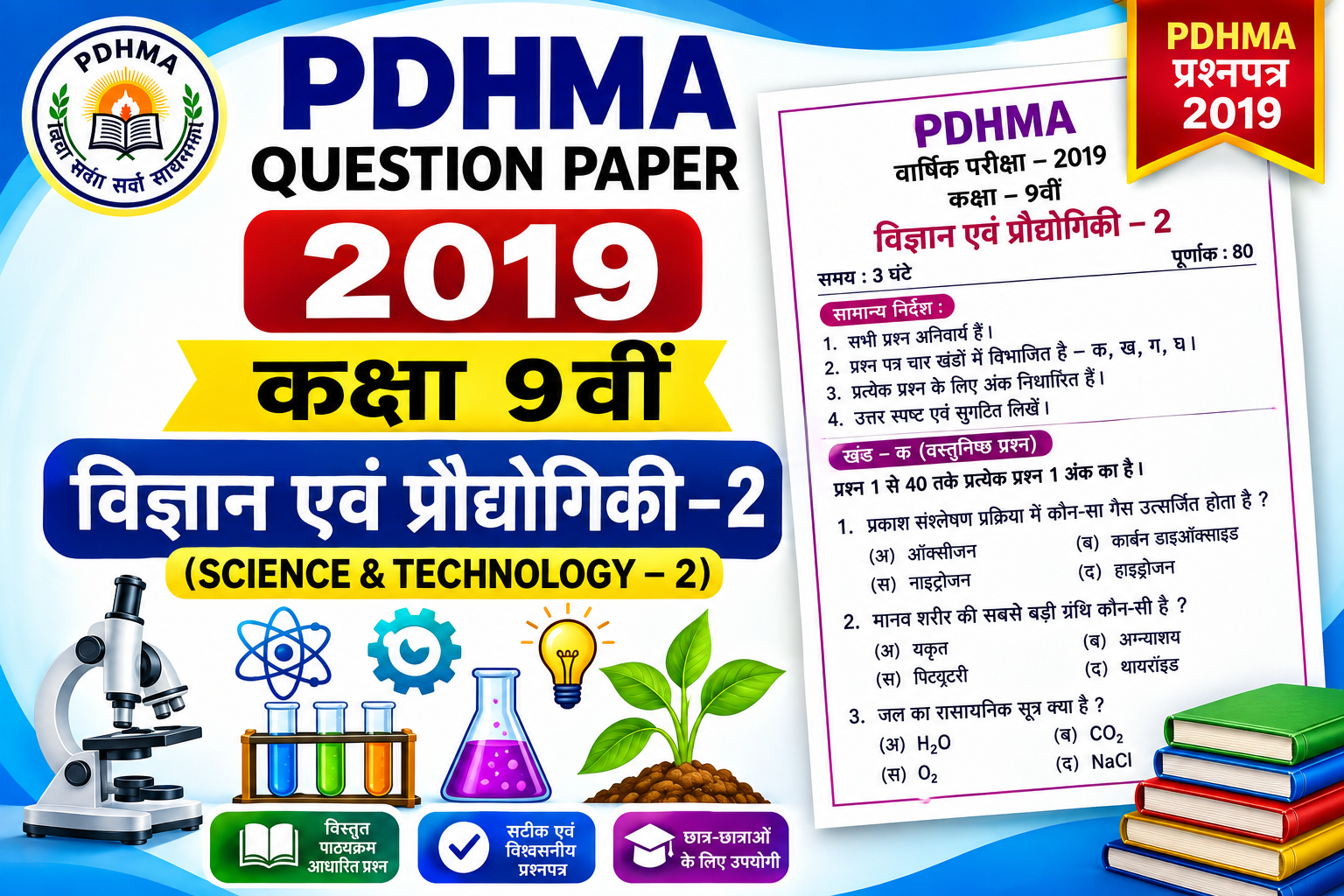
| Question Paper Year | 2019 |
| Resource Type | Previous-Year Question Paper |
| Main Purpose | Practice, Revision and Self-Assessment |
| Useful For | Students, Teachers and Parents |
| Preparation Method | Concept Understanding + Practice + Revision |
The exact marks, question count and paper structure should be checked from the original examination material. An older paper should not automatically be assumed to have the same pattern as a current examination.
Why Solve the PDHMA 9th Science & Technology-2 Question Paper?
Question-paper practice is important because it changes preparation from passive reading into active learning. Students have to recall information, understand what the question is asking and construct an appropriate response.
🔬 Concept Understanding
Practice questions help students check whether they truly understand a scientific concept rather than simply recognising it from the textbook.
📚 Revision
A question paper can help students revise several concepts and identify chapters that require additional attention.
📝 Answer Writing
Writing answers regularly helps students learn how to present scientific information clearly and logically.
🎯 Self-Assessment
After completing a paper, students can identify strong areas and weak areas and create a more focused revision plan.
⏱ Time Management
Timed practice helps students understand how much time they need for different types of questions.
💡 Confidence Building
Regular practice can make students more familiar with examination-style questions and improve their confidence.
How to Prepare for Class 9 Science & Technology-2
Preparation should begin with the current syllabus. Students should identify the chapters included in their course and divide them into manageable study sessions.
Start With the Textbook
Read the prescribed textbook carefully. Pay attention to definitions, illustrations, examples, activities, explanations and important scientific terms.
Understand the Concept
Try to understand why a scientific process occurs instead of memorising only the final statement. Ask yourself what happens, why it happens and what factors are involved.
Make Short Notes
Short revision notes can include definitions, important terms, processes, differences, diagrams and other key information from the current syllabus.
Practise Questions
After studying each chapter, solve textbook exercises and additional practice questions. Previous-year questions can be used after completing the relevant topics.
Analyse Mistakes
Whenever an answer is wrong, identify the reason. The mistake may be caused by a conceptual misunderstanding, incorrect recall, careless reading or calculation.
Important Study Areas for Science & Technology-2
The exact topics included in Science and Technology-2 depend on the applicable curriculum. Students should always use their current textbook and syllabus to determine the chapters they need to study.
Scientific Concepts
Understand the main scientific principles in every chapter. Try to explain each concept in your own words after studying it.
Definitions and Terminology
Learn important scientific terms accurately and understand their meanings. Correct terminology is important when writing science answers.
Processes and Explanations
Where a chapter describes a scientific process, understand the sequence of events and the reason behind each stage.
Diagrams and Labelling
If diagrams are included in the current syllabus, practise drawing and labelling them accurately.
Application-Based Questions
Practise applying scientific concepts to examples and situations rather than only memorising textbook sentences.
How to Solve the PDHMA 9th Science & Technology-2 Paper
Students should approach a science question paper calmly. Before writing, read the question carefully and identify the exact information being requested.
- Read the entire question. Do not start writing after reading only part of a long question.
- Identify the key words. Words such as define, explain, compare, identify, describe and give reasons can indicate the type of response expected.
- Recall the relevant concept. Think about the chapter and scientific principle connected with the question.
- Write a focused answer. Include the important information required by the question.
- Use scientific terminology. Write important scientific terms correctly.
- Show steps where required. For calculations or processes, present the relevant steps clearly.
- Review your work. Check diagrams, labels, calculations, units and unanswered questions.
Different Types of Science Questions to Practise
Students should practise different types of questions because an examination may require more than one form of response.
Definition Questions
These questions require a precise explanation of a scientific term. Students should understand the meaning rather than memorise a sentence without context.
Short Answer Questions
Short-answer questions require students to identify the central point and respond directly.
Explanation Questions
These questions require students to explain how or why something happens. Answers should include the relevant scientific reasoning.
Comparison Questions
When asked to differentiate between two concepts, students can organise the answer into separate points or a comparison table where appropriate.
Reason-Based Questions
For a question asking why something happens, students should provide the scientific reason rather than only repeating the result.
Diagram Questions
Where diagrams are included in the syllabus, students should practise both drawing and labelling important figures.
Objective Questions
Multiple-choice questions can test definitions, concepts, scientific facts and applications. Regular MCQ practice can improve quick recall and accuracy.
Science & Technology-2 Practice MCQs
The following multiple-choice questions are included as original practice questions for Class 9 Science and Technology preparation. They are not claimed to be the exact questions from the 2019 PDHMA paper. Students can use them for revision and self-assessment.
How to Prepare Using These MCQs
The practice MCQs above should not be treated simply as a list of answers to memorise. Students should use them to check whether they understand the underlying scientific concepts.
For example, if a question asks about heredity, do not memorise only the word “heredity.” Understand what heredity means, how characteristics can pass from parents to offspring and how inherited characteristics differ from acquired characteristics.
Similarly, questions about organs should be studied together with their functions. Understanding relationships between concepts makes it easier to answer questions when the wording changes.
After completing the MCQs, students should review the questions they answered incorrectly. Return to the relevant chapter and revise the concept before attempting similar questions again.
How to Improve MCQ Accuracy
Multiple-choice questions can look easy, but students sometimes make mistakes because they read too quickly. The best way to improve MCQ accuracy is to combine conceptual understanding with careful reading.
Read Every Option
Do not select an answer immediately after seeing the first option that looks correct. Read all the choices carefully.
Eliminate Clearly Incorrect Options
If you know that one or more options cannot be correct, eliminate them mentally. This can make the remaining choices easier to compare.
Look for Key Words
Words such as “mainly,” “correct,” “incorrect,” “not,” “always” or “best” can change the meaning of a question. Read them carefully.
Do Not Guess Without Thinking
Before choosing an option, recall the relevant scientific concept. A few seconds of careful thinking can prevent avoidable errors.
Review Difficult Questions
If the examination allows it, return to difficult MCQs after completing the questions you know well.
How to Analyse the 2019 Question Paper
After completing the PDHMA Question Paper 2019 9th Science & Technology-2, students should analyse the paper rather than simply looking at the final score.
Start by marking questions that were answered confidently. Then identify questions that were answered incorrectly and questions where you were unsure. The second and third categories require additional attention.
Next, group the mistakes according to topic. If several mistakes are connected with one chapter, that chapter should receive additional revision time.
Students can maintain a mistake notebook. Write the topic, the mistake and the correct concept in simple language. Review the notebook regularly.
Question → Mistake → Reason → Concept Revision → Similar Practice.
Common Mistakes in Class 9 Science & Technology
Memorising Without Understanding
Students sometimes memorise definitions and answers without understanding the concept. This can make unfamiliar questions difficult.
Ignoring Difficult Topics
Avoiding a difficult chapter does not solve the problem. Give additional time to concepts that are not yet clear.
Skipping Practice Questions
Reading a chapter is not enough. Students should regularly solve questions without looking at the answers.
Not Checking Units
Where numerical questions involve units, students should check them carefully.
Incorrect Diagram Labels
If diagrams are part of the syllabus, students should practise accurate labels and neat presentation.
Not Reviewing Mistakes
A question paper becomes much more useful when mistakes are analysed and corrected.
Importance of Diagrams in Science & Technology
Diagrams can help students understand scientific structures and processes. Where diagrams are included in the current syllabus, students should practise them regularly.
Students should not merely memorise the appearance of a diagram. They should understand what each part represents and why it is important.
During revision, try drawing important diagrams without looking at the textbook. Then compare the result with the textbook and correct missing or incorrect labels.
Neat presentation is also important. Labels should be readable and connected clearly to the correct part of the diagram.
Importance of Application-Based Questions
Application-based questions require students to use scientific knowledge in a particular situation. They are useful because they test understanding rather than simple recall.
To prepare for such questions, students should ask themselves how a concept works in everyday situations. Think about cause and effect and consider what would happen if a particular condition changed.
When solving an application question, first identify the scientific principle involved. Then connect that principle with the information provided in the question.
Time Management for Science & Technology-2
Time management should be practised before the actual examination. Students should learn how to balance objective questions, short answers, descriptive questions and other question types according to the applicable paper pattern.
Do not spend too much time on one difficult question. If the examination allows it, move ahead and return to the question later.
Keep enough time for checking. Review calculations, units, diagrams, labels and unanswered questions before submitting the paper.
The objective is not to finish as quickly as possible. The objective is to complete the paper accurately within the available time.
Final Revision Strategy for Science & Technology-2
As the examination approaches, students should focus on revision and practice. Avoid trying to learn the complete syllabus from the beginning during the final stage.
First revise the chapters that are difficult. Then review important concepts, definitions, terminology, processes and diagrams according to the current syllabus.
After that, attempt the previous-year question paper as a mock test. Analyse the mistakes and revise the related topics.
The practice MCQs included in this article can also be used for quick revision. However, students should always return to the textbook when an MCQ reveals a conceptual weakness.
Current Syllabus + Textbook + Concept Understanding + Practice Questions + MCQs + Previous-Year Paper + Mistake Analysis.
How Parents Can Help Class 9 Students
Parents can support students by helping them maintain a regular study schedule. A quiet study environment can make revision more productive.
Parents should encourage students to attempt questions independently instead of immediately providing answers. If a question is difficult, the student can return to the relevant textbook section and try again.
After a practice paper, parents can discuss which topics were difficult and encourage students to revise those topics.
Practice scores should be treated as feedback rather than as a final judgement of ability. The purpose of practice is to identify areas that can be improved.
How Teachers Can Use Previous-Year Questions
Teachers can use previous-year questions as supplementary classroom exercises. They can discuss a question, explain the relevant concept and then provide new questions based on the same concept.
Teachers can also ask students to explain why a particular answer is correct. This helps students develop deeper understanding.
MCQs can be used for quick classroom revision. Students can first choose their answers independently and then discuss the reasoning behind the correct option.
This approach makes objective questions more useful than simple memorisation.
Frequently Asked Questions
What is PDHMA Question Paper 2019 9th Science & Technology-2?
It refers to a previous-year Class 9 Science and Technology Part 2 question paper associated with the 2019 examination period. It can be used as a supplementary practice and revision resource.
Why should students solve the 2019 Science & Technology-2 paper?
It can help students practise scientific concepts, improve answer writing, manage time and identify topics that require additional revision.
Can I prepare only from the 2019 paper?
No. Students should primarily follow the current syllabus and prescribed textbook. The previous-year paper should be used as additional practice.
Are the MCQs in this article from the actual 2019 paper?
No. The MCQs included above are original practice questions created for revision. They are not presented as exact questions from the 2019 examination.
How can I improve my Science & Technology marks?
Understand concepts, revise regularly, solve chapter-wise questions, practise MCQs, review diagrams where required and analyse mistakes after completing practice papers.
How should I prepare for objective questions?
Understand important concepts and terminology, practise MCQs regularly and read every option carefully before selecting an answer.
Should I practise diagrams?
If diagrams are part of your current syllabus, yes. Practise drawing and labelling important diagrams accurately.
What should I do after getting an MCQ wrong?
Find the relevant concept in your textbook, understand it again and then attempt similar questions.
Is time management important in Science?
Yes. Students should practise completing different types of questions within an appropriate amount of time while leaving sufficient time for checking.
How often should I revise Science?
Regular short revision sessions are generally more useful than leaving the entire revision for the final days. Difficult topics can be reviewed more frequently.
Conclusion
The PDHMA Question Paper 2019 9th: Science & Technology-2 can be a useful supplementary resource for Class 9 students preparing for Science and Technology examinations. Previous-year question papers provide an opportunity to test knowledge, practise written answers, improve time management and identify weak areas.
Students should not depend only on the old question paper. The current syllabus, prescribed textbook and classroom learning should remain the foundation of preparation. The 2019 paper can then be used as an additional practice tool.
The practice MCQs included in this article can be used for quick revision and self-assessment. Students should focus on understanding why an answer is correct rather than simply memorising the answer letter.
A strong preparation strategy combines several methods: concept learning, textbook reading, chapter-wise exercises, MCQ practice, previous-year papers, mistake analysis and regular revision.
The most useful study cycle is: Understand → Practise → Check → Analyse → Revise → Practise Again.
By following this approach consistently, Class 9 students can make their Science and Technology-2 preparation more organised and improve their confidence before the examination.